Carmen M. Reinhart, Kenneth S. Rogoff, NBER: From Financial Crash to Debt Crisis. Newly developed long historical time series on public debt, along with modern data on external debts, allow a deeper analysis of the cycles underlying serial debt and banking crises. The evidence confirms a strong link between banking crises and sovereign default across the economic history of great many countries, advanced and emerging alike. The focus of the analysis is on three related hypotheses tested with both “world” aggregate levels and on an individual country basis. First, private debt surges are a recurring antecedent to banking crises; governments quite contribute to this stage of the borrowing boom. Second, banking crises (both domestic ones and those emanating from international financial centers) often precede or accompany sovereign debt crises. Indeed, we find they help predict them. Third, public borrowing accelerates markedly ahead of a sovereign debt crisis; governments often have “hidden debts” that far exceed the better documented levels of external debt. These hidden debts encompass domestic public debts (which prior to our data were largely undocumented).
Clemente De Lucia, BNP Paribas: Financial crisis and potential output. If the crisis were to lead to a new “equilibrium” with higher public debt, this would mean that sooner or later the level of taxation has to be increased, with negative effects on growth perspectives. Note that demographic developments are already exerting downward pressure on potential output. By contrast, the crisis could even trigger an acceleration of structural reforms in the eurozone. Making eurozone product and labour markets more flexible and more open to competition could increase growth prospects, creating the conditions for a “full recovery”. Under this more optimistic scenario, the level of potential output returns to its pre-crisis period. Finland, which faced a serious banking crisis in the early 1990s, is an example of output recovering completely from losses due to financial distress.
Ben Steverman, Business Week: Corporate Balance Sheets Show Surprising Strength. Despite a harsh recession and alluringly low interest rates, many companies have shrunk debt and other obligations over the past year U.S. large-cap companies have survived the recession without taking on loads of new debt. According to an analysis of Bloomberg data on nonfinancial companies in the Standard & Poor's 500-stock index, the average large-cap company has shrunk liabilities on its balance sheet by 8.2%. The liabilities on a company's balance sheet include its debts, as well as any other financial obligations, such as those toward pension plans. Stronger corporate balance sheets stand out at a time when government and consumer finances remain shaky.
Murat Tasci, Cleveland Fed: Are Jobless Recoveries the New Norm? Ultimately, whether we have a muted, jobless recovery or a rapid one featuring full employment gains will depend on the demand for labor. The unemployment rate is stabilizing, but unfortunately, the demand for workers has not been showing any signs of major improvement yet. Of course, some kinds of slack might exist that prevent rising demand for labor from translating immediately into new jobs. Employers could potentially ask for more hours from their current employees before hiring new workers. Similarly, part-time employees can be made full-time workers. A good measure of this potential slack is the number of workers employed part-time for economic reasons. Significant underemployment could be a major contributor to a jobless recovery.
Mark Vitner, Wells Fargo: Reflections on 25 Years Following The U.S. Economy. Over the past 25 years the greatest forecasting mistake economists have made is to underestimate economic growth. Paying too much attention to all the negatives in the economy tends to make economic forecast too pessimistic. Forecasters tended to overestimate the drag from federal budgets deficits during the late 1980s, the banking crisis in the early 1990s, and most of the subsequent crises that we faced during the past two decades. Many forecasters were also slow in recognizing that the potential growth rate of the economy had increased in the late 1990s with the advent of new information technologies.
Yener Altunbas, BIS: Does monetary policy affect bank risk-taking? This paper investigates the relationship between short-term interest rates and bank risk. Using a unique database that includes quarterly balance sheet information for listed banks operating in the European Union and the United States in the last decade, we find evidence that unusually low interest rates over an extended period of time contributed to an increase in banks' risk. This result holds for a wide range of measures of risk, as well as macroeconomic and institutional controls.
Joyce M. Dargay, Dermot Gately, NYU: World oil demand’s shift toward faster growing and less price-responsive products and regions. World oil demand has shifted toward products and regions that are faster growing and less price-responsive. In contrast to projections to 2030 of declining percapita demand for the world as a whole – by the U.S. Department of Energy (DOE), International Energy Agency (IEA) and OPEC – we project modest growth. Our projections for total world demand in 2030 are at least 20% higher than projections by those three institutions, using similar assumptions about income growth and oil prices, because we project rest-of-world growth that is consistent with historical patterns, in contrast to the dramatic slowdowns which they project.
Paul M. Romer, NBER: Which Parts of Globalization Matter for Catch-up Growth? Economists devote too much attention to international flows of goods and services and not enough to international flows of ideas. Traditional trade flows are an imperfect substitute for flows of the underlying ideas. The simplest textbook trade model shows that a welfare-enhancing move toward freer flows of ideas should be associated with a reduction in conventional trade. The large quantitative effect from the flow of ideas is evident in the second half of the 20th century as the life expectancies in poor and rich countries began to converge. Another example comes from China, where authorities dramatically reduced accident rates by adopting rules of civil aviation that were developed in the United States. All economists, including trade economists, would be better equipped to talk about international flows of technologies and rules if they adopted a consistent vocabulary based on the concepts of nonrivalry and excludability. An analysis of the interaction between rules and technologies may help explain important puzzles such as why private firms have successfully diffused some technologies (mobile telephony) but not others (safe municipal water.)
Pierre Koning, Carolyn J. Heinrich, IZA: Cream-Skimming, Parking and Other Intended and Unintended Effects of Performance-Based Contracting in Social Welfare Services. We analyze the incentive effects of performance-based contracts, as well as their impacts on provider job placement rates, using unique data on Dutch cohorts of unemployed and disabled workers that were assigned to private social welfare providers in 2002-2005. We take advantage of variation in contract design over this period, where procured contracts gradually moved from partial performance-contingent pay to contracts with 100%-performance contingent reward schemes, and analyze the impact of these changes using panel data that allow us to control for cohort types and to develop explicit measures of selection into the programs. We find evidence of cream-skimming and other gaming activities on the part of providers but little impact of these activities on job placement rates. Overall, moving to a system with contract payments fully contingent on performance appears to increase job placements for more readily employable workers, although it does not affect the duration of their jobs.
Douglas Almond, Janet Currie, NBER: Human Capital Development Before Age Five. Events before five years old can have large long term impacts on adult outcomes. Several longitudinal studies suggest that characteristics that are measured as of age 7 can explain a great deal of the variation in educational attainment, earnings as of the early 30s, and the probability of employment. Child and family characteristics measured at school entry do as much to explain future outcomes as factors that labor economists have more traditionally focused on, such as years of education. Yet while children can be permanently damaged at this age, an important message is that the damage can often be remediated. We provide a brief overview of evidence regarding the effectiveness of different types of policies to provide remediation.
Paul J. Burke, Andrew Leigh, IZA: Do Output Contractions Trigger Democratic Change? Does faster economic growth increase pressure for democratic change, or reduce it? Using data for 154 countries for the period 1963-2007, we examine the short-run relationship between economic growth and moves toward and away from greater democracy. To address the potential endogeneity of economic growth, we use variation in precipitation, temperatures, and commodity prices as instruments for a country’s rate of economic growth. Our results indicate that more rapid economic growth reduces the short-run likelihood of institutional change toward democracy. Output contractions due to adverse weather shocks appear to have a particularly important impact on the timing of democratic change.
Pierre Brochu et al, University of Ottawa: The ‘Trendiness’ of Sleep: An Empirical Investigation into the Cyclical Nature of Sleep Time. Using Canadian time use data, we exploit exogenous variation in local unemployment rates to investigate the cyclical nature of sleep time and show that for both men and women, sleep time decreases when the economy is doing relatively better. Our results suggest that in a recession Canadians sleep an average of 2 hours and 34 minutes more per week, or 22 minutes more per day. Given the importance of even small changes in sleep time on measures of cognitive functioning such as reaction time and concentration, our findings may help explain the countercyclical nature of mortality. Further, we find that sleep time should not be treated as exogenously determined, but, like any other resource, determined by its relative cost.
Friday, March 26, 2010

Friday, March 19, 2010
MARCH 19 2010
Paul Krugman, NYT Blog: How Much Of The World Is In a Liquidity Trap? Being in a liquidity trap reverses many of the usual rules of economic policy. Virtue becomes vice: attempts to save more actually make us poorer, in both the short and the long run. Prudence becomes folly: a stern determination to balance budgets and avoid any risk of inflation is the road to disaster. Mercantilism works: countries that subsidize exports and restrict imports actually do gain at their trading partners’ expense. How much of the world is currently in a liquidity trap? Almost all advanced countries. The US, obviously; Japan, even more obviously; the eurozone, because the ECB probably couldn’t engage in Fed-style quantitative easing even if it wanted to, given the lack of a single backing government; Britain. Essentially the whole advanced world, accounting for 70 percent of world GDP at market prices, is in a liquidity trap.
Laurel Graefe, Jacob Smith, Atlanta Fed: A look at the income-side estimates of growth. Last week, a post in the New York Times' blog on Okun's law made note of the statistical discrepancy between the two methods for calculating national output: "…there are two measures of output growth—the usual measure, which adds up total spending in the economy, and the alternative, which adds up total income. In theory, the two should be exactly the same. In practice, they have been very different during this recession… These GDI numbers suggest that output growth actually declined much more sharply than had been widely understood." Indeed, the recession looks deeper and the recovery seems much less pronounced, looking at the income-side data. History suggests that when these two measures of national output disagree, GDP tends to get revised in the direction of GDI and not the other way around. It would be prudent not to dismiss the latest divergence in the two measures because it suggests that the decline in national output has been more protracted, and the recovery more modest, than what is being reflected in GDP.
Joachim Fels et al, Morgan Stanley: What Fiscal Tightening? We continue to forecast solid, above-consensus global GDP growth of 4.4% this year - despite growth downgrades in Europe, a weaker 1Q in the US (largely weather-related) and the recent softening in the China Manufacturing PMI. At the same time, we think that downside risks for the global economy in 2011 are mounting. First, many central banks in EM are about to start tightening monetary policy, and we expect the Fed to nudge official rates higher from 3Q10 and thus earlier than markets currently expect. Second, our macro team is looking for significantly higher bond yields this year and for a sell-off in developed equity markets. If so, it would dampen growth prospects for next year further. Third, we expect sovereign debt concerns to spread throughout the advanced economies as fiscal policy in most developed countries is on an unsustainable path.
Nouriel Roubini, Project Syndicate: States of Risk. The dilemma is that, whereas fiscal consolidation is necessary to prevent an unsustainable increase in the spread on sovereign bonds, the short-run effects of raising taxes and cutting government spending tend to be contractionary. In countries like the euro-zone members, a loss of external competitiveness, caused by tight monetary policy and a strong currency, erosion of long-term comparative advantage relative to emerging markets, and wage growth in excess of productivity growth, impose further constraints on the resumption of growth. A vicious circle of public-finance deficits, current-account gaps, worsening external-debt dynamics, and stagnating growth can then set in. Eventually, this can lead to default on euro-zone members’ public and foreign debt, as well as exit from the monetary union by fragile economies unable to adjust and reform fast enough.
Prakash Loungani, IMF: Housing Prices: More Room to Fall? Though there are some signs of stabilization, the global correction in housing markets continued through 2009. House prices in the OECD economies fell on average about 5 percent in real terms between the fourth quarter of 2007 and the third quarter of 2009.House prices in most countries still remain well above the levels observed at the beginning of the upturn in the early 2000s. Prices remain above rents and incomes. Econometric models show that house prices increased during 2000–06 to a greater degree than can be explained by either short-run driving forces or long-run relationships: the corrections thus far have not erased all of the excesses generated by the house price increases. That leads to an uncomfortable conclusion: house prices in many countries still have room to fall.
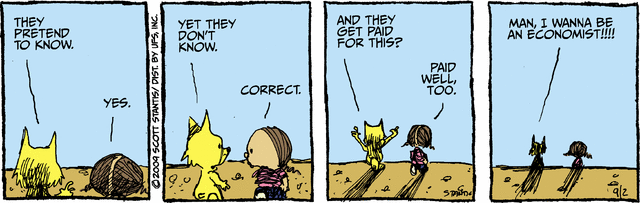
Robert J. Shiller, Project Syndicate: A Crisis of Understanding. Few economists predicted the current economic crisis, and there is little agreement among them about its ultimate causes. The problem for macroeconomics is that the types of causes mentioned for the current crisis are difficult to systematize. The mathematical models that macroeconomists have may resemble weather models in some respects, but their structural integrity is not guaranteed by anything like a solid, immutable theory. The most important new book about the origins of the economic crisis, Carmen Reinhart’s and Kenneth Rogoff’s This Time Is Different, is essentially a summary of lessons learned from virtually every financial crisis in every country in recorded history. But the book is almost entirely non-theoretical. This leaves us trying to use patterns from past, dissimilar crises to try to infer the likely prognosis for the current crisis. As a result, we simply do not know if the recovery will be solid or disappointing.
Huixin Bi, Eric M. Leeper, NBER: Sovereign Debt Risk Premia and Fiscal Policy in Sweden. What are the tradeoffs between short-run stabilization and long-run sustainability when the perceived riskiness of government debt depends, in part, on the current and expected fiscal environment in place? We calibrate a simple model to Swedish fiscal data in two periods: before and after the financial crisis of the early 1990s. We compute the dynamic fiscal limit, which depends on the peak of the Laffer curve, for the pre-crisis and three alternative post-crisis fiscal policies. The model simulates the macroeconomic consequences of alternative policies in the face of the sequence of bad output shocks that Sweden experienced from 1991-1997.
Carmen M. Reinhart, NBER: This Time is Different Chartbook: Country Histories on Debt, Default, and Financial Crises. This Chartbook provides a pictorial history, on a country-by-country basis, of public debt and economic crises of various forms. It is a timeline of a countrys creditworthiness and financial turmoil. The analysis, narrative, and illustrations in the book “This Time is Different” were primarily organized around themes (serial default, inflation, etc.), although detailed tables in the book chronicled country-specific information on the dating, frequency, incidence, etc. of specific crises episodes by country. The Chartbook compliments the thematic analysis with individual country histories, and provides the grounds for a systematic analysis of the temporal patterns of debt cycles, banking and sovereign debt crises, hyperinflation, and, for the post World War II period, the reliance on IMF programs.
Mark Whitehouse, WSJ Blog: Atlanta Fed’s Altig on Small Business’s Potential to Derail Recovery. In recent weeks, policy makers from President Barack Obama to Federal Reserve Chairman Ben Bernanke have been taking extraordinary measures to remove what they see as a serious impediment to the recovery: A dearth of credit for the small businesses that many economists say must play a leading role in creating new jobs. David Altig, head of research at the Atlanta Fed, notes that an outsized fraction of the job losses during this recession came from small businesses, particularly very small businesses with less than 50 employees. We’re looking for explanations. One obvious candidate is that this was the group that would have more difficulty with a credit event, which clearly this recession was.
Jaison R. Abel, Ishita Dey, and Todd M. Gabe, NY Fed: Productivity and the Density of Human Capital. We estimate a model of urban productivity in which the agglomeration effect of density is enhanced by a metropolitan area’s stock of human capital. Estimation accounts for potential biases due to the endogeneity of density and industrial composition effects. Using new information on output per worker for U.S. metropolitan areas along with a measure of density that accounts for the spatial distribution of population, we find that a doubling of density increases productivity by 2 to 4 percent. Consistent with theories of learning and knowledge spillovers in cities, we demonstrate that the elasticity of average labor productivity with respect to density increases with human capital. Metropolitan areas with a human capital stock one standard deviation below the mean realize no productivity gain, while doubling density in metropolitan areas with a human capital stock one standard deviation above the mean yields productivity benefits that are about twice the average.
Gary Becker, Becker Posner Blog: The Long-Term Unemployed: Consequences and Possible Cures. A current proposal in Washington is to give companies a subsidy if they hire workers who have been unemployed for longer than a few months. But the great majority of the new hires that would receive a subsidy under such a proposal to stimulate employment would have occurred anyway. The program would end up being another costly subsidy to businesses. The only real remedy for the long-term (and other) unemployed is to have the economy grow fast. It would help a lot if the leaders in Washington did not try to radically transform various aspects of the economy while we are recovering from a serious recession, and thereby magnify the high degree of uncertainty that is typically caused by a recession.
Deliana Kostova, VoxEU: Do higher cigarette prices deter smoking? Evidence from developing nations. Do higher cigarette prices deter smoking? This column finds that policymakers in developing countries could reduce cigarette consumption by youths by raising taxes. A 10% increase in the price will reduce youth cigarette demand by 18.3%.
Petter Lundborg, Paul Nystedt, Dan-Olof Rooth, IZA: No Country for Fat Men? Obesity, Earnings, Skills, and Health among 450,000 Swedish Men. We find that the crude obesity penalty in earnings, which amounts to about 18 percent, is linked to supply-side characteristics that are associated with both earnings and obesity. In particular, we show that the penalty reflects negative associations between obesity, on the one hand, and cognitive skills, non-cognitive skills, and physical fitness, on the other. Our results suggest that employers use obesity as a marker for skill limitations in order to statistically discriminate.
C. Eisenegger et al, University of Zurich: Prejudice and truth about the effect of testosterone on human bargaining behaviour. Evidence from animal studies in rodents shows that testosterone causes aggressive behaviour towards conspecifics. Folk wisdom generalizes and adapts these findings to humans, suggesting that testosterone induces antisocial, egoistic, or even aggressive human behaviours. Here we show that the sublingual administration of a single dose of testosterone in women causes a substantial increase in fair bargaining behaviour, thereby reducing bargaining conflicts and increasing the efficiency of social interactions. However, subjects who believed that they received testosterone—regardless of whether they actually received it or not—behaved much more unfairly than those who believed that they were treated with placebo. Thus, the folk hypothesis seems to generate a strong negative association between subjects’ beliefs and the fairness of their offers, even though testosterone administration actually causes a substantial increase in the frequency of fair bargaining offers in our experiment.
Isabelle Brocas, Juan D. Carrillo, VoxEU: Neuroeconomic theory: Using neuroscience to understand the bounds of rationality. Neuroeconomic theory will soon play a crucial role in the building of new reliable theories capable of explaining and predicting individual behaviour and strategic choices. The main message is that the individual is not one coherent body. The brain is a multi-system entity (with conflicting objectives, restricted information, etc.) and therefore the decision-maker must be modelled as an organisation. We conclude with an analogy. Before the so-called modern theory of the firm, organisations were modelled as individual players characterised by an input-output production function. The systematic study of interactions between agents and decision processes within organisations (acknowledging informational asymmetries, incentive problems, restricted communications channels, hierarchical structures, etc.) led to novel economic insights. Applying a similar methodology to study individual decision-making is, in our view, the most fruitful way to understand the bounds of rationality.
Laurel Graefe, Jacob Smith, Atlanta Fed: A look at the income-side estimates of growth. Last week, a post in the New York Times' blog on Okun's law made note of the statistical discrepancy between the two methods for calculating national output: "…there are two measures of output growth—the usual measure, which adds up total spending in the economy, and the alternative, which adds up total income. In theory, the two should be exactly the same. In practice, they have been very different during this recession… These GDI numbers suggest that output growth actually declined much more sharply than had been widely understood." Indeed, the recession looks deeper and the recovery seems much less pronounced, looking at the income-side data. History suggests that when these two measures of national output disagree, GDP tends to get revised in the direction of GDI and not the other way around. It would be prudent not to dismiss the latest divergence in the two measures because it suggests that the decline in national output has been more protracted, and the recovery more modest, than what is being reflected in GDP.
Joachim Fels et al, Morgan Stanley: What Fiscal Tightening? We continue to forecast solid, above-consensus global GDP growth of 4.4% this year - despite growth downgrades in Europe, a weaker 1Q in the US (largely weather-related) and the recent softening in the China Manufacturing PMI. At the same time, we think that downside risks for the global economy in 2011 are mounting. First, many central banks in EM are about to start tightening monetary policy, and we expect the Fed to nudge official rates higher from 3Q10 and thus earlier than markets currently expect. Second, our macro team is looking for significantly higher bond yields this year and for a sell-off in developed equity markets. If so, it would dampen growth prospects for next year further. Third, we expect sovereign debt concerns to spread throughout the advanced economies as fiscal policy in most developed countries is on an unsustainable path.
Nouriel Roubini, Project Syndicate: States of Risk. The dilemma is that, whereas fiscal consolidation is necessary to prevent an unsustainable increase in the spread on sovereign bonds, the short-run effects of raising taxes and cutting government spending tend to be contractionary. In countries like the euro-zone members, a loss of external competitiveness, caused by tight monetary policy and a strong currency, erosion of long-term comparative advantage relative to emerging markets, and wage growth in excess of productivity growth, impose further constraints on the resumption of growth. A vicious circle of public-finance deficits, current-account gaps, worsening external-debt dynamics, and stagnating growth can then set in. Eventually, this can lead to default on euro-zone members’ public and foreign debt, as well as exit from the monetary union by fragile economies unable to adjust and reform fast enough.
Prakash Loungani, IMF: Housing Prices: More Room to Fall? Though there are some signs of stabilization, the global correction in housing markets continued through 2009. House prices in the OECD economies fell on average about 5 percent in real terms between the fourth quarter of 2007 and the third quarter of 2009.House prices in most countries still remain well above the levels observed at the beginning of the upturn in the early 2000s. Prices remain above rents and incomes. Econometric models show that house prices increased during 2000–06 to a greater degree than can be explained by either short-run driving forces or long-run relationships: the corrections thus far have not erased all of the excesses generated by the house price increases. That leads to an uncomfortable conclusion: house prices in many countries still have room to fall.
Robert J. Shiller, Project Syndicate: A Crisis of Understanding. Few economists predicted the current economic crisis, and there is little agreement among them about its ultimate causes. The problem for macroeconomics is that the types of causes mentioned for the current crisis are difficult to systematize. The mathematical models that macroeconomists have may resemble weather models in some respects, but their structural integrity is not guaranteed by anything like a solid, immutable theory. The most important new book about the origins of the economic crisis, Carmen Reinhart’s and Kenneth Rogoff’s This Time Is Different, is essentially a summary of lessons learned from virtually every financial crisis in every country in recorded history. But the book is almost entirely non-theoretical. This leaves us trying to use patterns from past, dissimilar crises to try to infer the likely prognosis for the current crisis. As a result, we simply do not know if the recovery will be solid or disappointing.
Huixin Bi, Eric M. Leeper, NBER: Sovereign Debt Risk Premia and Fiscal Policy in Sweden. What are the tradeoffs between short-run stabilization and long-run sustainability when the perceived riskiness of government debt depends, in part, on the current and expected fiscal environment in place? We calibrate a simple model to Swedish fiscal data in two periods: before and after the financial crisis of the early 1990s. We compute the dynamic fiscal limit, which depends on the peak of the Laffer curve, for the pre-crisis and three alternative post-crisis fiscal policies. The model simulates the macroeconomic consequences of alternative policies in the face of the sequence of bad output shocks that Sweden experienced from 1991-1997.
Carmen M. Reinhart, NBER: This Time is Different Chartbook: Country Histories on Debt, Default, and Financial Crises. This Chartbook provides a pictorial history, on a country-by-country basis, of public debt and economic crises of various forms. It is a timeline of a countrys creditworthiness and financial turmoil. The analysis, narrative, and illustrations in the book “This Time is Different” were primarily organized around themes (serial default, inflation, etc.), although detailed tables in the book chronicled country-specific information on the dating, frequency, incidence, etc. of specific crises episodes by country. The Chartbook compliments the thematic analysis with individual country histories, and provides the grounds for a systematic analysis of the temporal patterns of debt cycles, banking and sovereign debt crises, hyperinflation, and, for the post World War II period, the reliance on IMF programs.
Mark Whitehouse, WSJ Blog: Atlanta Fed’s Altig on Small Business’s Potential to Derail Recovery. In recent weeks, policy makers from President Barack Obama to Federal Reserve Chairman Ben Bernanke have been taking extraordinary measures to remove what they see as a serious impediment to the recovery: A dearth of credit for the small businesses that many economists say must play a leading role in creating new jobs. David Altig, head of research at the Atlanta Fed, notes that an outsized fraction of the job losses during this recession came from small businesses, particularly very small businesses with less than 50 employees. We’re looking for explanations. One obvious candidate is that this was the group that would have more difficulty with a credit event, which clearly this recession was.
Jaison R. Abel, Ishita Dey, and Todd M. Gabe, NY Fed: Productivity and the Density of Human Capital. We estimate a model of urban productivity in which the agglomeration effect of density is enhanced by a metropolitan area’s stock of human capital. Estimation accounts for potential biases due to the endogeneity of density and industrial composition effects. Using new information on output per worker for U.S. metropolitan areas along with a measure of density that accounts for the spatial distribution of population, we find that a doubling of density increases productivity by 2 to 4 percent. Consistent with theories of learning and knowledge spillovers in cities, we demonstrate that the elasticity of average labor productivity with respect to density increases with human capital. Metropolitan areas with a human capital stock one standard deviation below the mean realize no productivity gain, while doubling density in metropolitan areas with a human capital stock one standard deviation above the mean yields productivity benefits that are about twice the average.
Gary Becker, Becker Posner Blog: The Long-Term Unemployed: Consequences and Possible Cures. A current proposal in Washington is to give companies a subsidy if they hire workers who have been unemployed for longer than a few months. But the great majority of the new hires that would receive a subsidy under such a proposal to stimulate employment would have occurred anyway. The program would end up being another costly subsidy to businesses. The only real remedy for the long-term (and other) unemployed is to have the economy grow fast. It would help a lot if the leaders in Washington did not try to radically transform various aspects of the economy while we are recovering from a serious recession, and thereby magnify the high degree of uncertainty that is typically caused by a recession.
Deliana Kostova, VoxEU: Do higher cigarette prices deter smoking? Evidence from developing nations. Do higher cigarette prices deter smoking? This column finds that policymakers in developing countries could reduce cigarette consumption by youths by raising taxes. A 10% increase in the price will reduce youth cigarette demand by 18.3%.
Petter Lundborg, Paul Nystedt, Dan-Olof Rooth, IZA: No Country for Fat Men? Obesity, Earnings, Skills, and Health among 450,000 Swedish Men. We find that the crude obesity penalty in earnings, which amounts to about 18 percent, is linked to supply-side characteristics that are associated with both earnings and obesity. In particular, we show that the penalty reflects negative associations between obesity, on the one hand, and cognitive skills, non-cognitive skills, and physical fitness, on the other. Our results suggest that employers use obesity as a marker for skill limitations in order to statistically discriminate.
C. Eisenegger et al, University of Zurich: Prejudice and truth about the effect of testosterone on human bargaining behaviour. Evidence from animal studies in rodents shows that testosterone causes aggressive behaviour towards conspecifics. Folk wisdom generalizes and adapts these findings to humans, suggesting that testosterone induces antisocial, egoistic, or even aggressive human behaviours. Here we show that the sublingual administration of a single dose of testosterone in women causes a substantial increase in fair bargaining behaviour, thereby reducing bargaining conflicts and increasing the efficiency of social interactions. However, subjects who believed that they received testosterone—regardless of whether they actually received it or not—behaved much more unfairly than those who believed that they were treated with placebo. Thus, the folk hypothesis seems to generate a strong negative association between subjects’ beliefs and the fairness of their offers, even though testosterone administration actually causes a substantial increase in the frequency of fair bargaining offers in our experiment.
Isabelle Brocas, Juan D. Carrillo, VoxEU: Neuroeconomic theory: Using neuroscience to understand the bounds of rationality. Neuroeconomic theory will soon play a crucial role in the building of new reliable theories capable of explaining and predicting individual behaviour and strategic choices. The main message is that the individual is not one coherent body. The brain is a multi-system entity (with conflicting objectives, restricted information, etc.) and therefore the decision-maker must be modelled as an organisation. We conclude with an analogy. Before the so-called modern theory of the firm, organisations were modelled as individual players characterised by an input-output production function. The systematic study of interactions between agents and decision processes within organisations (acknowledging informational asymmetries, incentive problems, restricted communications channels, hierarchical structures, etc.) led to novel economic insights. Applying a similar methodology to study individual decision-making is, in our view, the most fruitful way to understand the bounds of rationality.
Friday, March 12, 2010
MARCH 12 2010
Pelin Berkmen et al, IMF: The Global Financial Crisis: Explaining Cross-Country Differences in the Output Impact. Countries with more leveraged domestic financial systems and more rapid credit growth tended to suffer larger downward revisions to their growth outlooks. For emerging markets, this financial channel trumps the trade channel. For a broader set of developing countries, however, the trade channel seems to have mattered, with countries exporting more advanced manufacturing goods more affected than those exporting food. Exchange-rate flexibility clearly helped in buffering the impact of the shock. There is also some —weaker—evidence that countries with a stronger fiscal position prior to the crisis were hit less severely. We find little evidence for the importance of other policy variables.
Felix Hüfner and Isabell Koske, OECD: Explaining household saving rates in G7 countries: implications for Germany. We analyse the determinants of household saving rates in the G7 countries since the 1970s in a panel co-integration framework. Unlike many previous studies, our specification allows for heterogeneity in the long- and short-run parameters across countries and explicitly distinguishes between financial liberalisation effects and wealth effects. Apart from finding that income developments as well as real interest rates and inflation are influencing household savings in most countries, results suggest that wealth effects through house and stock prices play a role in many countries, notably over the more recent period. According to the model, the recent increase in the German saving rate is due to two factors: Firstly, the actual saving rate was below its estimated equilibrium level at the end of the 1990s, implying an upward correction over the medium term. Secondly, the equilibrium saving rate has moved upwards in the first half of the 2000s, largely because of declines in stock prices.
Mary Daly And Bart Hobijn, San Fransisco Fed: Okun’s Law and the Unemployment Surprise. In 2009, strong growth in productivity allowed firms to lay off large numbers of workers while holding output relatively steady. This behavior threw a wrench into the long-standing relationship between changes in GDP and changes in the unemployment rate, known as Okun’s law. If Okun’s law had held in 2009, the unemployment rate would have risen by about half as much as it did over the course of the year.
Paul Beaudry, David A. Green, Benjamin M. Sand, NBER: How Much Is Employment Increased by Cutting Labor Costs? Estimating the Elasticity of Job Creation. The main finding of the paper is that U.S. labor market outcomes observed at the city-industry level appear to conform well to the restrictions implied by search and bargaining theory and, using 10-year differences, we estimate the elasticity of the job creation curve with respect to wages to be -0.3. We interpret this relatively low elasticity as reflecting a low propensity for individuals to become more entrepreneurial and create more jobs when labor costs are lower and variable profits are higher.
Jan van Ours, VoxEU: Age, wage, and productivity. Ageing populations are a concern for many developed countries, with increasing dependence on the working population expected. Despite this, there is relatively little research on how productivity changes with age. This column argues that while older people do not run as fast, there is no evidence of a mental productivity decline and little evidence of an increasing pay-productivity gap. The negative effects of ageing on productivity should not be exaggerated.
Edward L. Glaeser, Boston Globe: Why the anti-urban bias? The billions of dollars being spent on infrastructure across the nation provide an opportunity to plan for a better America, but politics-as-usual favors sprawl over city. This anti-urban bias of national policies must end. Over the past 60 years, cities have been hit by a painful policy trifecta: subsidization of highways, subsidization of homeownership, and a school system that creates strong incentives for many parents to leave city borders. Subsidizing transportation decreases the advantage of living close together in cities. It is a mistake to think that spending on trains balances the scales. Cities will always benefit far less than exurbs from transportation because dense areas already have good means of getting around, like walking.
Sara Markowitz, Erik Nesson, Joshua Robinson, NBER: Are Pink Slips Better Than Flu Shots? The Effects of Employment on Influenza Rates. In this paper, we examine whether increases in labor market activities are associated with an increased incidence of the flu. Flu data come from the Centers for Disease Control. We check the robustness of our results using unique data from Google Flu Trends. Using a first-difference two stage least squares estimation approach, we find that a one percentage point increase in the employment rate increases the number of influenza related doctor visits by about 8.1 additional flu-related doctor visits per 1000 doctor visits for all causes. To put this in perspective, on average, 33 additional people out of every 100,000 new employees will have a flu-related doctor visit. The results are robust across several specifications.
Paul Krugman, Princeton: Climate Policy, A Note. I’m trying to do a popular writeup of debates over climate change policy, which meant that I had to get a grip on the big dispute over the timing of action – Nordhaus and other modelers calling for a “climate policy ramp” in which carbon prices start fairly low and rise only gradually, Stern and others calling for a quick rise in prices. I found the discussion hard to follow, so I did what I usually do in such cases – tried to write down a toy model that hopefully clarifies the issues. And it leaves me both understanding and worried about the climate policy ramp.
Sam Dillon, NYT: Panel Proposes Single Standard for All Schools. A panel of educators convened by the nation’s governors and state school superintendents proposed a uniform set of academic standards on Wednesday, laying out their vision for what all the nation’s public school children should learn in math and English, year by year, from kindergarten to high school graduation. The new proposals could transform American education, replacing the patchwork of standards ranging from mediocre to world-class that have been written by local educators in every state. Under the proposed standards for English, for example, fifth graders would be expected to explain the differences between drama and prose, and to identify elements of drama like characters, dialogue and stage directions. Seventh graders would study, among other math concepts, proportional relationships, operations with rational numbers and solutions for linear equations.
Gustavo A. Marrero, Juan G. Rodríguez, ECINEQ: Inequality of opportunity and growth. Theoretical and empirical studies exploring the effects of income inequality upon growth reach a disappointing inconclusive result. This paper postulates that one reason for this ambiguity is that income inequality is actually a composite measure of at least two different sorts of inequality: inequality of opportunity and inequality of returns to effort. These two types of inequality affect growth through opposite channels, so the relationship between income inequality and growth is positive or negative depending on which component is larger. We test this proposal using inequality-of-opportunity measures computed from the PSID database for 23 states of the U.S. in 1980 and 1990. We find robust support for a negative relationship between inequality of opportunity and growth, and a positive relationship between inequality of returns to effort and growth.
Andrew Leigh, ANU: Permanent Income Inequality: Australia, Britain, Germany, and the United States Compared. I find (1) using pre-government income, annual inequality and permanent inequality have grown in Germany and the US, while post-government income inequality has grown in the US; (2) comparing levels of annual post-government income inequality across countries, the ranking was the US, Australia, Britain, Germany; (3) comparing levels of permanent income inequality across countries, the ranking of triennial post-government inequality in the most recent year was the US, Australia, Germany, Britain; (4) in the most recent year, the most mobile country was Australia, while the least mobile was Germany. However, as a comparison of points (2) and (3) demonstrates, mobility had little effect on the overall rankings.
Thomas A. Garrett, Russell M. Rhine St Louis Fed: "Economic Freedom and Employment Growth in U.S. States. We find that states with greater economic freedom – defined as the protection of private property and private markets operating with minimal government interference – experienced greater rates of employment growth. In addition, we find that less restrictive state and national government labor market policies have the greatest impact on employment growth in U.S. states. Except for labor market policies, we find that state employment growth is influenced by state and local government policies, but not the policies of all levels of government, including the national government. Our results suggest that policy-makers concerned with employment should seriously consider the degree to which their own labor market policies, as well as those of the national government, may be limiting economic growth and development in their respective states.
John Cassidy, New Yorker: No Credit. Timothy Geithner’s financial plan is working—and making him very unpopular. “We saved the economy, but we kind of lost the public,” Geithner said. For all the wrath that has descended upon his slight frame, he appears to have succeeded in putting out another inferno. “Why do policymakers screw up financial crises?” he said before I left his office. “They screw up financial crises because the politics are horrible, and that deters action. They are slow and late and tentative and weak because they are scared to death of the politics. But sometimes a policymaker has to say, I’ll take pain now against pain later.”
Jan-Emmanuel De Neve, James H. Fowler, Bruno S. Frey, CESIFO: Genes, Economics, and Happiness. This article presents evidence of a specific gene that predicts subjective well-being. Using data from the National Longitudinal Study of Adolescent Health, we show that individuals with a transcriptionally more efficient version of the serotonin transporter gene (5HTT) are significantly more likely to report higher levels of life satisfaction. Having one or two alleles of the more efficient type raises the average likelihood of being very satisfied with one’s life by 8.5% and 17.3%, respectively. This result may help to explain the stable component of happiness and suggests that genetic association studies can help us to better understand individual heterogeneity in subjective well-being.
Felix Hüfner and Isabell Koske, OECD: Explaining household saving rates in G7 countries: implications for Germany. We analyse the determinants of household saving rates in the G7 countries since the 1970s in a panel co-integration framework. Unlike many previous studies, our specification allows for heterogeneity in the long- and short-run parameters across countries and explicitly distinguishes between financial liberalisation effects and wealth effects. Apart from finding that income developments as well as real interest rates and inflation are influencing household savings in most countries, results suggest that wealth effects through house and stock prices play a role in many countries, notably over the more recent period. According to the model, the recent increase in the German saving rate is due to two factors: Firstly, the actual saving rate was below its estimated equilibrium level at the end of the 1990s, implying an upward correction over the medium term. Secondly, the equilibrium saving rate has moved upwards in the first half of the 2000s, largely because of declines in stock prices.
Mary Daly And Bart Hobijn, San Fransisco Fed: Okun’s Law and the Unemployment Surprise. In 2009, strong growth in productivity allowed firms to lay off large numbers of workers while holding output relatively steady. This behavior threw a wrench into the long-standing relationship between changes in GDP and changes in the unemployment rate, known as Okun’s law. If Okun’s law had held in 2009, the unemployment rate would have risen by about half as much as it did over the course of the year.
Paul Beaudry, David A. Green, Benjamin M. Sand, NBER: How Much Is Employment Increased by Cutting Labor Costs? Estimating the Elasticity of Job Creation. The main finding of the paper is that U.S. labor market outcomes observed at the city-industry level appear to conform well to the restrictions implied by search and bargaining theory and, using 10-year differences, we estimate the elasticity of the job creation curve with respect to wages to be -0.3. We interpret this relatively low elasticity as reflecting a low propensity for individuals to become more entrepreneurial and create more jobs when labor costs are lower and variable profits are higher.
Jan van Ours, VoxEU: Age, wage, and productivity. Ageing populations are a concern for many developed countries, with increasing dependence on the working population expected. Despite this, there is relatively little research on how productivity changes with age. This column argues that while older people do not run as fast, there is no evidence of a mental productivity decline and little evidence of an increasing pay-productivity gap. The negative effects of ageing on productivity should not be exaggerated.
Edward L. Glaeser, Boston Globe: Why the anti-urban bias? The billions of dollars being spent on infrastructure across the nation provide an opportunity to plan for a better America, but politics-as-usual favors sprawl over city. This anti-urban bias of national policies must end. Over the past 60 years, cities have been hit by a painful policy trifecta: subsidization of highways, subsidization of homeownership, and a school system that creates strong incentives for many parents to leave city borders. Subsidizing transportation decreases the advantage of living close together in cities. It is a mistake to think that spending on trains balances the scales. Cities will always benefit far less than exurbs from transportation because dense areas already have good means of getting around, like walking.
Sara Markowitz, Erik Nesson, Joshua Robinson, NBER: Are Pink Slips Better Than Flu Shots? The Effects of Employment on Influenza Rates. In this paper, we examine whether increases in labor market activities are associated with an increased incidence of the flu. Flu data come from the Centers for Disease Control. We check the robustness of our results using unique data from Google Flu Trends. Using a first-difference two stage least squares estimation approach, we find that a one percentage point increase in the employment rate increases the number of influenza related doctor visits by about 8.1 additional flu-related doctor visits per 1000 doctor visits for all causes. To put this in perspective, on average, 33 additional people out of every 100,000 new employees will have a flu-related doctor visit. The results are robust across several specifications.
Paul Krugman, Princeton: Climate Policy, A Note. I’m trying to do a popular writeup of debates over climate change policy, which meant that I had to get a grip on the big dispute over the timing of action – Nordhaus and other modelers calling for a “climate policy ramp” in which carbon prices start fairly low and rise only gradually, Stern and others calling for a quick rise in prices. I found the discussion hard to follow, so I did what I usually do in such cases – tried to write down a toy model that hopefully clarifies the issues. And it leaves me both understanding and worried about the climate policy ramp.
Sam Dillon, NYT: Panel Proposes Single Standard for All Schools. A panel of educators convened by the nation’s governors and state school superintendents proposed a uniform set of academic standards on Wednesday, laying out their vision for what all the nation’s public school children should learn in math and English, year by year, from kindergarten to high school graduation. The new proposals could transform American education, replacing the patchwork of standards ranging from mediocre to world-class that have been written by local educators in every state. Under the proposed standards for English, for example, fifth graders would be expected to explain the differences between drama and prose, and to identify elements of drama like characters, dialogue and stage directions. Seventh graders would study, among other math concepts, proportional relationships, operations with rational numbers and solutions for linear equations.
Gustavo A. Marrero, Juan G. Rodríguez, ECINEQ: Inequality of opportunity and growth. Theoretical and empirical studies exploring the effects of income inequality upon growth reach a disappointing inconclusive result. This paper postulates that one reason for this ambiguity is that income inequality is actually a composite measure of at least two different sorts of inequality: inequality of opportunity and inequality of returns to effort. These two types of inequality affect growth through opposite channels, so the relationship between income inequality and growth is positive or negative depending on which component is larger. We test this proposal using inequality-of-opportunity measures computed from the PSID database for 23 states of the U.S. in 1980 and 1990. We find robust support for a negative relationship between inequality of opportunity and growth, and a positive relationship between inequality of returns to effort and growth.
Andrew Leigh, ANU: Permanent Income Inequality: Australia, Britain, Germany, and the United States Compared. I find (1) using pre-government income, annual inequality and permanent inequality have grown in Germany and the US, while post-government income inequality has grown in the US; (2) comparing levels of annual post-government income inequality across countries, the ranking was the US, Australia, Britain, Germany; (3) comparing levels of permanent income inequality across countries, the ranking of triennial post-government inequality in the most recent year was the US, Australia, Germany, Britain; (4) in the most recent year, the most mobile country was Australia, while the least mobile was Germany. However, as a comparison of points (2) and (3) demonstrates, mobility had little effect on the overall rankings.
Thomas A. Garrett, Russell M. Rhine St Louis Fed: "Economic Freedom and Employment Growth in U.S. States. We find that states with greater economic freedom – defined as the protection of private property and private markets operating with minimal government interference – experienced greater rates of employment growth. In addition, we find that less restrictive state and national government labor market policies have the greatest impact on employment growth in U.S. states. Except for labor market policies, we find that state employment growth is influenced by state and local government policies, but not the policies of all levels of government, including the national government. Our results suggest that policy-makers concerned with employment should seriously consider the degree to which their own labor market policies, as well as those of the national government, may be limiting economic growth and development in their respective states.
John Cassidy, New Yorker: No Credit. Timothy Geithner’s financial plan is working—and making him very unpopular. “We saved the economy, but we kind of lost the public,” Geithner said. For all the wrath that has descended upon his slight frame, he appears to have succeeded in putting out another inferno. “Why do policymakers screw up financial crises?” he said before I left his office. “They screw up financial crises because the politics are horrible, and that deters action. They are slow and late and tentative and weak because they are scared to death of the politics. But sometimes a policymaker has to say, I’ll take pain now against pain later.”
Jan-Emmanuel De Neve, James H. Fowler, Bruno S. Frey, CESIFO: Genes, Economics, and Happiness. This article presents evidence of a specific gene that predicts subjective well-being. Using data from the National Longitudinal Study of Adolescent Health, we show that individuals with a transcriptionally more efficient version of the serotonin transporter gene (5HTT) are significantly more likely to report higher levels of life satisfaction. Having one or two alleles of the more efficient type raises the average likelihood of being very satisfied with one’s life by 8.5% and 17.3%, respectively. This result may help to explain the stable component of happiness and suggests that genetic association studies can help us to better understand individual heterogeneity in subjective well-being.
Friday, March 5, 2010
MARCH 5 2010
Jan Hatzius et al, Chicago University: Financial Conditions Indexes: A Fresh Look after the Financial Crisis. This report explores the link between financial conditions and economic activity. We first review existing measures, including both single indicators and composite financial conditions indexes (FCIs). We then build a new FCI that features three key innovations. First, besides interest rates and asset prices, it includes a broad range of quantitative and survey-based indicators. Second, our use of unbalanced panel estimation techniques results in a longer time series (back to 1970) than available for other indexes. Third, we control for past GDP growth and inflation and thus focus on the predictive power of financial conditions for future economic activity. During most of the past two decades for which comparisons are possible, including the last five years, our FCI shows a tighter link with future economic activity than existing indexes, although some of this undoubtedly reflects the fact that we selected the variables partly based on our observation of the recent financial crisis. As of the end of 2009, our FCI showed financial conditions at somewhat worse-than-normal levels. The main reason is that quantitative credit measures (e.g. asset-backed securities issuance) remain very weak, especially once we control for past economic growth. Thus, our analysis is consistent with an ongoing modest drag from financial conditions on economic growth in 2010.
Alberto Musso, Stefano Neri, Livio Stracca, ECB: Housing, consumption and monetary policy how different are the US and the euro area? The paper presents evidence from Structural Vector Autoregressions (SVAR) by focusing on the e¤ects of three structural shocks, (i) monetary policy, (ii) credit supply and (iii) housing demand shocks on the housing market and the broader economy. We find that similarities overshadow differences as far as the role of the housing market is concerned. We find evidence pointing in the direction of a stronger role for housing in the transmission of monetary policy shocks in the US, while the evidence is less clearcut for housing demand shocks. We also find that credit supply shocks matter more in the euro area.
Lorenzo Cappiello et al, VoxEU: The effect of bank loans and credit standards on output. How important is credit availability to the real economy? This column examines evidence from the Eurozone and suggests that a change in loan availability has a positive and statistically significant effect on GDP. This provides support for the policies taken by central banks to alleviate pressures on the banking system.
Martin Feldstein, Project Syndicate: How Safe Are Your Dollars? Chinese officials and private investors around the world have been worrying aloud about whether their dollar investments are safe. Since the Chinese government holds a large part of its $2 trillion of foreign exchange in dollars, they have good reason to focus on the future value of the greenback. And investors with smaller dollar holdings, who can shift to other currencies much more easily than the Chinese, are right to ask themselves whether they should be diversifying into non-dollar assets – or even shunning the dollar completely.
Behzad Kianian, Kei-Mu Yi, Philadelphia Fed: China’s Emergence as a Manufacturing Juggernaut: Is It Overstated? The wages of China’s manufacturing workers are rising rapidly; and China’s production of export goods relies heavily on imported inputs and the final exported goods face large mark-ups in their destination markets. The first theme implies that China will lose global market share in some categories of goods. The second implies that China’s trading relationship with many countries is complementary, not competitive, and that the omnipresence of China’s goods exaggerates the extent of its manufacturing performance. China’s emergence as a global manufacturing power should not be overstated, and concerns that China will “take over” all manufacturing markets are unfounded.
Egbert L.W. Jongen, CPB: Child care subsidies revisited. Public spending on child care has taken a high flight in the Netherlands. One of the key policy goals of child care subsidies is to stimulate labour participation. We study the impact of child care subsidies on labour participation using a general equilibrium model. Next to the labour supply choice, we also model the choice over formal and informal care. The choice between formal and informal care plays an important role in the overall impact of child care subsidies on labour participation. The model is calibrated to Dutch data. Our analysis shows that existing child care subsidies have promoted labour participation. However, at the current average subsidy rate of almost 80%, a further increase in the subsidy rate is a rather ineffective way to promote formal participation, the main effect being substitution of informal for formal care.
Lorenzo Bini Smaghi, ECB: Slaves of defunct economists. The economist John Maynard Keynes is back in fashion”, writes Robert Skidelsky. A question that comes to mind in reading these words is why Keynes had to make a comeback in the first place, why the General Theory was forgotten and its prescriptions abandoned. There are two possible answers to the question. The first is that the Theory is not general, and thus cannot apply to all economic states of the world. The second is that Keynes’ famous admonition in the last page of his General Theory – according to which “Practical men, who believe themselves to be quite exempt from any intellectual influences, are usually the slaves of some defunct economist” – has been turned upside down. In other words, defunct economists – and their theories – are usually enslaved by practical men who do not fully understand them.
Alfonso Arpaia, Nicola Curci, ECFIN: EU labour market behaviour during the Great Recession. At this juncture, the major risks concern the possibility that unemployed people become disenfranchised from the labour market and, thus, that high unemployment does not curb the growth of real wages (i.e. becomes structural unemployment). Apart from being a constraint to the recovery in the short term, a decline in the labour supply may heavily affect the potential output. However, reforms in many countries have strengthened the labour market attachment of most vulnerable groups and a large reduction in the overall activity rate is less likely now than in the past.
Ayşegül Şahin, Joseph Song, Bart Hobijn, NY Fed: The Unemployment Gender Gap during the 2007 Recession. Women fared decidedly better than men during the most recent recession. By August 2009, the unemployment rate for men had hit 11.0 percent, while that for women held at 8.3 percent. This 2.7 percentage point unemployment gender gap—the largest in the postwar era—appears to reflect two factors: First, men were much more heavily represented in the industries that suffered the most during the downturn. Second, there was a much sharper increase in the percentage of men who—prompted, perhaps, by a decline in household liquidity—rejoined the labor force but failed to find a job.
Nuria Rodriguez-Planas, IZA: Longer-Term Impacts of Mentoring, Educational Services, and Incentives to Learn: Evidence from a Randomized Trial. This paper is the first to use a randomized trial in the US to analyze the short- and long-term educational and employment impacts of an after-school program, the Quantum Opportunity Program, that offered disadvantaged high-school youth: mentoring, educational services, and financial rewards with the objective to improve high-school graduation and post-secondary schooling enrollment. Average impacts reveal that the hefty beneficial educational outcomes quickly faded away. Heterogeneity matters. While encouraging results are found for the younger youth; detrimental long-lived outcomes for males suggest that extrinsic rewards may be crowding out intrinsic motivation. Evidence by sites' funding source, which led to implementation differences, supports this hypothesis.
Xavier Sala-i-Martin, Maxim Pinkovskiy , NBER: African Poverty is Falling...Much Faster than You Think! We estimate income distributions, poverty rates, and inequality and welfare indices for African countries for the period 1970-2006. We show that: (1) African poverty is falling and is falling rapidly; (2) if present trends continue, the poverty Millennium Development Goal of halving the proportion of people with incomes less than one dollar a day will be achieved on time; (3) the growth spurt that began in 1995 decreased African income inequality instead of increasing it; (4) African poverty reduction is remarkably general: it cannot be explained by a large country, or even by a single set of countries possessing some beneficial geographical or historical characteristic.
Bockerman, Petri et al, MPRA: Does physical capacity explain the height premium? The paper examines the role of physical capacity in the determination of the height premium by using the “Health 2000 in Finland” data that contain both self-reported information on the physical strenuousness of work, and information on muscle mass from medical examinations. Our results show that the height premium does not vary according to the physical strenuousness of work. We also find that muscle mass is not related to wages. Furthermore, we observe that the shortest men do physically very demanding work and the tallest do sedentary work, even after controlling for the effects of age and education.
Alex Tabarrok, Marginal Revolution Blog: The Philosophical Cow. Suppose that you are a cow philosopher contemplating the welfare of cows. In the world today there are about 1.3 billion of your compatriots. It would be a fine thing for cows if all cows were well treated and if none were slaughtered for food. Nevertheless, being a clever cow, you understand that it's the demand for beef that brings cows to life. How do you regard such a trade off? If each cow brought to life adds even some small bit of cow utility to the grand total of cow welfare must not beef eaters be lauded, at least if they are hungry enough?
Alberto Musso, Stefano Neri, Livio Stracca, ECB: Housing, consumption and monetary policy how different are the US and the euro area? The paper presents evidence from Structural Vector Autoregressions (SVAR) by focusing on the e¤ects of three structural shocks, (i) monetary policy, (ii) credit supply and (iii) housing demand shocks on the housing market and the broader economy. We find that similarities overshadow differences as far as the role of the housing market is concerned. We find evidence pointing in the direction of a stronger role for housing in the transmission of monetary policy shocks in the US, while the evidence is less clearcut for housing demand shocks. We also find that credit supply shocks matter more in the euro area.
Lorenzo Cappiello et al, VoxEU: The effect of bank loans and credit standards on output. How important is credit availability to the real economy? This column examines evidence from the Eurozone and suggests that a change in loan availability has a positive and statistically significant effect on GDP. This provides support for the policies taken by central banks to alleviate pressures on the banking system.
Martin Feldstein, Project Syndicate: How Safe Are Your Dollars? Chinese officials and private investors around the world have been worrying aloud about whether their dollar investments are safe. Since the Chinese government holds a large part of its $2 trillion of foreign exchange in dollars, they have good reason to focus on the future value of the greenback. And investors with smaller dollar holdings, who can shift to other currencies much more easily than the Chinese, are right to ask themselves whether they should be diversifying into non-dollar assets – or even shunning the dollar completely.
Behzad Kianian, Kei-Mu Yi, Philadelphia Fed: China’s Emergence as a Manufacturing Juggernaut: Is It Overstated? The wages of China’s manufacturing workers are rising rapidly; and China’s production of export goods relies heavily on imported inputs and the final exported goods face large mark-ups in their destination markets. The first theme implies that China will lose global market share in some categories of goods. The second implies that China’s trading relationship with many countries is complementary, not competitive, and that the omnipresence of China’s goods exaggerates the extent of its manufacturing performance. China’s emergence as a global manufacturing power should not be overstated, and concerns that China will “take over” all manufacturing markets are unfounded.
Egbert L.W. Jongen, CPB: Child care subsidies revisited. Public spending on child care has taken a high flight in the Netherlands. One of the key policy goals of child care subsidies is to stimulate labour participation. We study the impact of child care subsidies on labour participation using a general equilibrium model. Next to the labour supply choice, we also model the choice over formal and informal care. The choice between formal and informal care plays an important role in the overall impact of child care subsidies on labour participation. The model is calibrated to Dutch data. Our analysis shows that existing child care subsidies have promoted labour participation. However, at the current average subsidy rate of almost 80%, a further increase in the subsidy rate is a rather ineffective way to promote formal participation, the main effect being substitution of informal for formal care.
Lorenzo Bini Smaghi, ECB: Slaves of defunct economists. The economist John Maynard Keynes is back in fashion”, writes Robert Skidelsky. A question that comes to mind in reading these words is why Keynes had to make a comeback in the first place, why the General Theory was forgotten and its prescriptions abandoned. There are two possible answers to the question. The first is that the Theory is not general, and thus cannot apply to all economic states of the world. The second is that Keynes’ famous admonition in the last page of his General Theory – according to which “Practical men, who believe themselves to be quite exempt from any intellectual influences, are usually the slaves of some defunct economist” – has been turned upside down. In other words, defunct economists – and their theories – are usually enslaved by practical men who do not fully understand them.
Alfonso Arpaia, Nicola Curci, ECFIN: EU labour market behaviour during the Great Recession. At this juncture, the major risks concern the possibility that unemployed people become disenfranchised from the labour market and, thus, that high unemployment does not curb the growth of real wages (i.e. becomes structural unemployment). Apart from being a constraint to the recovery in the short term, a decline in the labour supply may heavily affect the potential output. However, reforms in many countries have strengthened the labour market attachment of most vulnerable groups and a large reduction in the overall activity rate is less likely now than in the past.
Ayşegül Şahin, Joseph Song, Bart Hobijn, NY Fed: The Unemployment Gender Gap during the 2007 Recession. Women fared decidedly better than men during the most recent recession. By August 2009, the unemployment rate for men had hit 11.0 percent, while that for women held at 8.3 percent. This 2.7 percentage point unemployment gender gap—the largest in the postwar era—appears to reflect two factors: First, men were much more heavily represented in the industries that suffered the most during the downturn. Second, there was a much sharper increase in the percentage of men who—prompted, perhaps, by a decline in household liquidity—rejoined the labor force but failed to find a job.
Nuria Rodriguez-Planas, IZA: Longer-Term Impacts of Mentoring, Educational Services, and Incentives to Learn: Evidence from a Randomized Trial. This paper is the first to use a randomized trial in the US to analyze the short- and long-term educational and employment impacts of an after-school program, the Quantum Opportunity Program, that offered disadvantaged high-school youth: mentoring, educational services, and financial rewards with the objective to improve high-school graduation and post-secondary schooling enrollment. Average impacts reveal that the hefty beneficial educational outcomes quickly faded away. Heterogeneity matters. While encouraging results are found for the younger youth; detrimental long-lived outcomes for males suggest that extrinsic rewards may be crowding out intrinsic motivation. Evidence by sites' funding source, which led to implementation differences, supports this hypothesis.
Xavier Sala-i-Martin, Maxim Pinkovskiy , NBER: African Poverty is Falling...Much Faster than You Think! We estimate income distributions, poverty rates, and inequality and welfare indices for African countries for the period 1970-2006. We show that: (1) African poverty is falling and is falling rapidly; (2) if present trends continue, the poverty Millennium Development Goal of halving the proportion of people with incomes less than one dollar a day will be achieved on time; (3) the growth spurt that began in 1995 decreased African income inequality instead of increasing it; (4) African poverty reduction is remarkably general: it cannot be explained by a large country, or even by a single set of countries possessing some beneficial geographical or historical characteristic.
Bockerman, Petri et al, MPRA: Does physical capacity explain the height premium? The paper examines the role of physical capacity in the determination of the height premium by using the “Health 2000 in Finland” data that contain both self-reported information on the physical strenuousness of work, and information on muscle mass from medical examinations. Our results show that the height premium does not vary according to the physical strenuousness of work. We also find that muscle mass is not related to wages. Furthermore, we observe that the shortest men do physically very demanding work and the tallest do sedentary work, even after controlling for the effects of age and education.
Alex Tabarrok, Marginal Revolution Blog: The Philosophical Cow. Suppose that you are a cow philosopher contemplating the welfare of cows. In the world today there are about 1.3 billion of your compatriots. It would be a fine thing for cows if all cows were well treated and if none were slaughtered for food. Nevertheless, being a clever cow, you understand that it's the demand for beef that brings cows to life. How do you regard such a trade off? If each cow brought to life adds even some small bit of cow utility to the grand total of cow welfare must not beef eaters be lauded, at least if they are hungry enough?
Friday, February 26, 2010
FEBRUARY 26 2010
Stephen G Cecchetti, M S Mohanty, Fabrizio Zampolli: The Future of Public Debt: Prospects and Implications. Fiscal problems facing industrial economies are bigger than suggested by official debt figures that show the implications of the financial crisis on fiscal balances. Large public debts have significant financial and real consequences. The recent sharp rise in risk premia on long-term bonds issued by several industrial countries suggests that markets no longer consider sovereign debt low-risk. The limited evidence we have suggests default risk premia move up with debt levels and down with the revenue share of GDP as well as the availability of private saving. We note the risk that persistently high levels of public debt will drive down capital accumulation, productivity growth and long-term potential growth potential. A recent study suggests that there may be non-linear effects of public debt on growth. Looming long-term fiscal imbalances pose significant risk to the prospects for future monetary stability. We describe two channels through which unstable debt dynamics could lead to higher inflation – direct debt monetisation and the temptation to reduce the real value of government debt through higher inflation.
Richard Berner, Morgan Stanley: We Can't Inflate Our Way Out. Adding fuel to the fire, a growing chorus of household-name economists from both sides of the political aisle appears to be advocating higher inflation as the remedy for our fiscal maladies. Indeed, many believe that higher inflation will cure multiple ills, and that central banks should raise their inflation targets to as high as 4% from the current ones (some implicit) that cluster near 2%. From a policy perspective, we couldn't disagree more. As we see it, central bank responses to this financial crisis underscore the fact that inflation targets are medium-term goals to be met flexibly; they have not limited central banks from responding aggressively to the shock.
Aki Ito, Patrick Rial, Bloomberg: Rogoff Says China Crisis May Trigger Regional Slump. China’s economic growth will plunge to as low as 2 percent following the collapse of a “debt- fueled bubble” within 10 years, sparking a regional recession, according to Harvard University Professor Kenneth Rogoff. “You’re not going to go a decade without having a bump in the business cycle,” Rogoff, former chief economist at the International Monetary Fund, said in an interview in Tokyo yesterday. “We would learn just how important China is when that happens. It would cause a recession everywhere surrounding” the country, including Japan and South Korea, and be “horrible” for Latin American commodity exporters, he said.
Christopher J. Neely, St Louise Fed: Okun’s Law: Output and Unemployment. U.S. output growth declined less than in most other industrialized countries while U.S. unemployment rose higher and faster than it did in most other major industrialized countries. Economists have long noted that most industrialized countries have larger Okun coefficients than do the United States and—to a lesser extent—Canada and the United Kingdom. In other words, most industrialized countries’ unemployment rates tend to vary less for a given gross domestic product (GDP) fluctuation than does that of the United States. The usual explanation for this is that the United States, Canada, and the United Kingdom have less heavily regulated labor markets in which businesses can more easily lay people off during slowdowns. Most countries have some combination of stronger implicit social job protections (e.g., Japan), stronger unions, or greater formal restrictions on releasing workers.
Robert J. Gordon, Northwestern University: Okun’s Law, Productivity Innovations, And Conundrums in Business Cycle Dating. Regression analysis reveals regular features of postwar business cycles, including lags of hours and employment behind output and leads of productivity changes ahead of output changes. While Okun’s Law was roughly accurate until 1986, regressions for the post 1986 period turn Okun’s Law on its head. The elasticity of changes in the hours gap to the output gap was 0.74 before 1986, close to Okun’s 2/3, but rose after 1986 to 1.2. Productivity no longer exhibits procyclical fluctuations, rendering as obsolete both the Real Business Cycle model and those aspects of modern macro that include productivity shocks as an explanation of business cycles. Productivity grows slowest in the later stages of the business cycle expansion and most rapidly in the early phase of the business cycle recovery. And this is nothing new.
Gauti Eggertsson, NY Fed: The Paradox of Toil. Suppose everyone wakes up one day and decides they want to work more. What happens to aggregate employment? This paper shows that, under certain conditions, aggregate employment falls; that is, there is less work in the aggregate because everyone wants to work more. The conditions for the paradox to apply are that the short-term nominal interest rate is zero and there are deflationary pressures and output contraction, much as during the Great Depression in the United States and, perhaps, the 2008 financial crisis in large parts of the world. The paradox of toil is tightly connected to the Keynesian idea of the paradox of thrift. Both are examples of a fallacy of composition.
Mark Thoma, Economist’s View Blog: Who Pays the Costs of the Recession? The recession is taking away opportunity for the young to gain employment experience, and many who are employed are working below their abilities in jobs they are likely to get stuck in for many years, if not forever. The recession is wiping out the accumulated assets of the unemployed as they try to bridge the gap until jobs return, and since many of these are older workers, this will have a large detrimental effect that lasts throughout their retirement years. Recessions cause skills to depreciate, there are psychological costs, there are costs to family members, the loss of a job generally means loss of health care, the costs to working class households go on and on. And there are other ways in which the costs have been distributed unequally, and in many cases these have not been thoroughly examined. For example, there is evidence that minority groups were given higher cost and highly profitable mortgages when lower cost but less profitable loans were available. This also served to wipe out accumulated assets of minority borrowers in addition to all the other problems that come when a high cost mortgage cannot be paid.
J. Bradford DeLong Blog: Economists for Wage Subsidies. Draft Letter to the Congress: A well-designed temporary and incremental hiring tax credit is a cost-effective way to create jobs, and could work well in the current environment. At a time when GDP is beginning to rise and demand is starting to return, private firms are likely to respond to such a tax incentive by hiring sooner and more aggressively than they otherwise would have done. Such a credit could thus help put Americans back to work more quickly than otherwise. And by targeting firms that are growing, such a tax credit supports the businesses most likely to lead the recovery of employment.
Alan S. Blinder, Washington Post: Getting the biggest bang for job-creation bucks. There are two key design elements in any tax credit for job-creation: minimizing the amount of the tax cut that is wasted (in this case, loses revenue without creating jobs) and minimizing possibilities for gaming the system. Many new jobs that receive the tax credit would have been created anyway. By increasing the demand for labor, the tax credit will drive up wages (which is good), which will in turn kill some other jobs (which is not good). Standard economic research can be used to estimate each of these three effects. The conclusion, in very round numbers, is that a $5,000-per-job tax credit similar to the administration's proposal should cost around $30,000 to $40,000 for each job created. Such estimates assume that most firms will not increase employment at all. Unfortunately, we know far less about the second problem: Gaming the system.
David Leonhardt, NYT: Judging Stimulus by Job Data Reveals Success. Just look at the outside evaluations of the stimulus. Perhaps the best-known economic research firms are IHS Global Insight, Macroeconomic Advisers and Moody’s Economy.com. They all estimate that the bill has added 1.6 million to 1.8 million jobs so far and that its ultimate impact will be roughly 2.5 million jobs. The Congressional Budget Office, an independent agency, considers these estimates to be conservative. The jobless rate is now expected to begin falling consistently by the end of this year. For that, the stimulus package, flaws and all, deserves a big heaping of credit.
Rajiv Sethi, Macroeconomic Resilience Blog: Natural Selection, Self-Deception and the Moral Hazard Explanation of the Financial Crisis. The current regime of explicit and implicit bank creditor protection and regulatory capital requirements means that a highly levered balance sheet invested in “safe” assets with severely negatively skewed payoffs is the optimal strategy to maximise the moral hazard free lunch. Reaching this optimum does not require explicit intentionality on the part of economic actors. The same may be achieved via a Hayekian spontaneous order of agents reacting to local incentives or even more generally through “natural selection”-like mechanisms.
Michael R. Crittenden, Marshall Eckblad, WSJ: Lending Falls at Epic Pace. U.S. banks posted last year their sharpest decline in lending since 1942, suggesting that the industry's continued slide is making it harder for the economy to recover. While top-tier banks are recovering at a faster clip, the rest of the industry is still suffering, according to a quarterly report from the Federal Deposit Insurance Corp. Banks fighting for survival, especially those plagued by losses on commercial real estate, are less willing to extend loans, siphoning credit from businesses and consumers.
Gary Becker, Becker Posner Blog: Should the Government try to Stimulate US Exports? The US has China over the barrel. For the US could threaten to inflate away much of the burden of its debt, and thereby greatly reduce the real value of China’s assets. The US could also use the Fed to maintain relatively low interest rates, even though this would likely increase inflation as well. …China may be willing to take some losses in order to pressure the US in its military relations to Taiwan, and other geo-political areas of conflict. But its threats in the government bond market have little credibility since China would suffer much more than the US would.
David Laibson, Johanna Mollerstrom, Harvard: Capital Flows, Consumption Booms and Asset Bubbles: A Behavioural Alternative to the Savings Glut Hypothesis. Bernanke (2005) hypothesized that a “global savings glut” was causing large trade imbalances. However, we show that the global savings rates did not show a robust upward trend during the relevant period. Moreover, if there had been a global savings glut there should have been a large investment boom in the countries that imported capital. Instead, those countries experienced consumption booms. National asset bubbles explain the international imbalances. The bubbles raised consumption, resulting in large trade deficits. In a sample of 18 OECD countries plus China, movements in home prices alone explain half of the variation in trade deficits.
Sagiri Kitao, NY Fed: Labor-Dependent Capital Income Taxation That Encourages Work and Saving. This paper proposes a simple mechanism of capital taxation that is negatively correlated with labor supply. Using a life-cycle model of heterogeneous agents, I show that this tax scheme provides a strong work incentive when households possess large assets and high productivity later in the life cycle, when they would otherwise work less. This reformed system also adds to the saving motive and raises aggregate capital. Moreover, the increased economic activities expand the tax base, and the revenue-neutral reform results in a lower average tax rate. My findings show that this tax scheme improves long-run welfare and that the majority of current generations would experience a welfare gain from a transition to the reformed system.
Larissa MacFarquhar, The New Yorker: The Deflationist. How Paul Krugman found politics. In his columns, Krugman is belligerently, obsessively political, but this aspect of his personality is actually a recent development. His parents were New Deal liberals, but they weren’t especially interested in politics. In his academic work, Krugman focussed mostly on subjects with little political salience. During the eighties, he thought that supply-side economics was stupid, but he didn’t think that much about it. Unlike Wells, who was so upset when Reagan was elected that she moved to England, Krugman found Reagan comical rather than evil. “I feel now like I was sleepwalking through the twenty years before 2000.” Translating unmappable facts into economic discourse, it turned out, was what Krugman was better at than anyone else: he could take an intriguing notion that had come up in real-world discussions, pare away the details (knowing just what to take out and what was essential), and refine what was left into a clean, clever, “cute” (as he liked to put it), and simple model. “It’s poetry,” Kenneth Rogoff, an economist at Harvard, says. “I mean, you go back to his first book and there was this beautiful chart about what the Volcker contraction did to output that swept aside so much—he just drew this little graph which really cleared the air. I’ve heard economists use the word ‘poet’ in describing him for decades.”
Nicholas O. Rule*, Nalini Ambady, Tufts University: Democrats and Republicans Can Be Differentiated from Their Faces. Individuals' political affiliations could be accurately discerned from their faces. Perceivers were able to accurately distinguish whether U.S. Senate candidates were either Democrats or Republicans based on photos of their faces. These effects extended to Democrat and Republican college students, based on their senior yearbook photos. These judgments were related to differences in perceived traits among the Democrat and Republican faces. Republicans were perceived as more powerful than Democrats. Moreover, as individual targets were perceived to be more powerful, they were more likely to be perceived as Republicans by others. Similarly, as individual targets were perceived to be warmer, they were more likely to be perceived as Democrats.
Richard Berner, Morgan Stanley: We Can't Inflate Our Way Out. Adding fuel to the fire, a growing chorus of household-name economists from both sides of the political aisle appears to be advocating higher inflation as the remedy for our fiscal maladies. Indeed, many believe that higher inflation will cure multiple ills, and that central banks should raise their inflation targets to as high as 4% from the current ones (some implicit) that cluster near 2%. From a policy perspective, we couldn't disagree more. As we see it, central bank responses to this financial crisis underscore the fact that inflation targets are medium-term goals to be met flexibly; they have not limited central banks from responding aggressively to the shock.
Aki Ito, Patrick Rial, Bloomberg: Rogoff Says China Crisis May Trigger Regional Slump. China’s economic growth will plunge to as low as 2 percent following the collapse of a “debt- fueled bubble” within 10 years, sparking a regional recession, according to Harvard University Professor Kenneth Rogoff. “You’re not going to go a decade without having a bump in the business cycle,” Rogoff, former chief economist at the International Monetary Fund, said in an interview in Tokyo yesterday. “We would learn just how important China is when that happens. It would cause a recession everywhere surrounding” the country, including Japan and South Korea, and be “horrible” for Latin American commodity exporters, he said.
Christopher J. Neely, St Louise Fed: Okun’s Law: Output and Unemployment. U.S. output growth declined less than in most other industrialized countries while U.S. unemployment rose higher and faster than it did in most other major industrialized countries. Economists have long noted that most industrialized countries have larger Okun coefficients than do the United States and—to a lesser extent—Canada and the United Kingdom. In other words, most industrialized countries’ unemployment rates tend to vary less for a given gross domestic product (GDP) fluctuation than does that of the United States. The usual explanation for this is that the United States, Canada, and the United Kingdom have less heavily regulated labor markets in which businesses can more easily lay people off during slowdowns. Most countries have some combination of stronger implicit social job protections (e.g., Japan), stronger unions, or greater formal restrictions on releasing workers.
Robert J. Gordon, Northwestern University: Okun’s Law, Productivity Innovations, And Conundrums in Business Cycle Dating. Regression analysis reveals regular features of postwar business cycles, including lags of hours and employment behind output and leads of productivity changes ahead of output changes. While Okun’s Law was roughly accurate until 1986, regressions for the post 1986 period turn Okun’s Law on its head. The elasticity of changes in the hours gap to the output gap was 0.74 before 1986, close to Okun’s 2/3, but rose after 1986 to 1.2. Productivity no longer exhibits procyclical fluctuations, rendering as obsolete both the Real Business Cycle model and those aspects of modern macro that include productivity shocks as an explanation of business cycles. Productivity grows slowest in the later stages of the business cycle expansion and most rapidly in the early phase of the business cycle recovery. And this is nothing new.
Gauti Eggertsson, NY Fed: The Paradox of Toil. Suppose everyone wakes up one day and decides they want to work more. What happens to aggregate employment? This paper shows that, under certain conditions, aggregate employment falls; that is, there is less work in the aggregate because everyone wants to work more. The conditions for the paradox to apply are that the short-term nominal interest rate is zero and there are deflationary pressures and output contraction, much as during the Great Depression in the United States and, perhaps, the 2008 financial crisis in large parts of the world. The paradox of toil is tightly connected to the Keynesian idea of the paradox of thrift. Both are examples of a fallacy of composition.
Mark Thoma, Economist’s View Blog: Who Pays the Costs of the Recession? The recession is taking away opportunity for the young to gain employment experience, and many who are employed are working below their abilities in jobs they are likely to get stuck in for many years, if not forever. The recession is wiping out the accumulated assets of the unemployed as they try to bridge the gap until jobs return, and since many of these are older workers, this will have a large detrimental effect that lasts throughout their retirement years. Recessions cause skills to depreciate, there are psychological costs, there are costs to family members, the loss of a job generally means loss of health care, the costs to working class households go on and on. And there are other ways in which the costs have been distributed unequally, and in many cases these have not been thoroughly examined. For example, there is evidence that minority groups were given higher cost and highly profitable mortgages when lower cost but less profitable loans were available. This also served to wipe out accumulated assets of minority borrowers in addition to all the other problems that come when a high cost mortgage cannot be paid.
J. Bradford DeLong Blog: Economists for Wage Subsidies. Draft Letter to the Congress: A well-designed temporary and incremental hiring tax credit is a cost-effective way to create jobs, and could work well in the current environment. At a time when GDP is beginning to rise and demand is starting to return, private firms are likely to respond to such a tax incentive by hiring sooner and more aggressively than they otherwise would have done. Such a credit could thus help put Americans back to work more quickly than otherwise. And by targeting firms that are growing, such a tax credit supports the businesses most likely to lead the recovery of employment.
Alan S. Blinder, Washington Post: Getting the biggest bang for job-creation bucks. There are two key design elements in any tax credit for job-creation: minimizing the amount of the tax cut that is wasted (in this case, loses revenue without creating jobs) and minimizing possibilities for gaming the system. Many new jobs that receive the tax credit would have been created anyway. By increasing the demand for labor, the tax credit will drive up wages (which is good), which will in turn kill some other jobs (which is not good). Standard economic research can be used to estimate each of these three effects. The conclusion, in very round numbers, is that a $5,000-per-job tax credit similar to the administration's proposal should cost around $30,000 to $40,000 for each job created. Such estimates assume that most firms will not increase employment at all. Unfortunately, we know far less about the second problem: Gaming the system.
David Leonhardt, NYT: Judging Stimulus by Job Data Reveals Success. Just look at the outside evaluations of the stimulus. Perhaps the best-known economic research firms are IHS Global Insight, Macroeconomic Advisers and Moody’s Economy.com. They all estimate that the bill has added 1.6 million to 1.8 million jobs so far and that its ultimate impact will be roughly 2.5 million jobs. The Congressional Budget Office, an independent agency, considers these estimates to be conservative. The jobless rate is now expected to begin falling consistently by the end of this year. For that, the stimulus package, flaws and all, deserves a big heaping of credit.
Rajiv Sethi, Macroeconomic Resilience Blog: Natural Selection, Self-Deception and the Moral Hazard Explanation of the Financial Crisis. The current regime of explicit and implicit bank creditor protection and regulatory capital requirements means that a highly levered balance sheet invested in “safe” assets with severely negatively skewed payoffs is the optimal strategy to maximise the moral hazard free lunch. Reaching this optimum does not require explicit intentionality on the part of economic actors. The same may be achieved via a Hayekian spontaneous order of agents reacting to local incentives or even more generally through “natural selection”-like mechanisms.
Michael R. Crittenden, Marshall Eckblad, WSJ: Lending Falls at Epic Pace. U.S. banks posted last year their sharpest decline in lending since 1942, suggesting that the industry's continued slide is making it harder for the economy to recover. While top-tier banks are recovering at a faster clip, the rest of the industry is still suffering, according to a quarterly report from the Federal Deposit Insurance Corp. Banks fighting for survival, especially those plagued by losses on commercial real estate, are less willing to extend loans, siphoning credit from businesses and consumers.
Gary Becker, Becker Posner Blog: Should the Government try to Stimulate US Exports? The US has China over the barrel. For the US could threaten to inflate away much of the burden of its debt, and thereby greatly reduce the real value of China’s assets. The US could also use the Fed to maintain relatively low interest rates, even though this would likely increase inflation as well. …China may be willing to take some losses in order to pressure the US in its military relations to Taiwan, and other geo-political areas of conflict. But its threats in the government bond market have little credibility since China would suffer much more than the US would.
David Laibson, Johanna Mollerstrom, Harvard: Capital Flows, Consumption Booms and Asset Bubbles: A Behavioural Alternative to the Savings Glut Hypothesis. Bernanke (2005) hypothesized that a “global savings glut” was causing large trade imbalances. However, we show that the global savings rates did not show a robust upward trend during the relevant period. Moreover, if there had been a global savings glut there should have been a large investment boom in the countries that imported capital. Instead, those countries experienced consumption booms. National asset bubbles explain the international imbalances. The bubbles raised consumption, resulting in large trade deficits. In a sample of 18 OECD countries plus China, movements in home prices alone explain half of the variation in trade deficits.
Sagiri Kitao, NY Fed: Labor-Dependent Capital Income Taxation That Encourages Work and Saving. This paper proposes a simple mechanism of capital taxation that is negatively correlated with labor supply. Using a life-cycle model of heterogeneous agents, I show that this tax scheme provides a strong work incentive when households possess large assets and high productivity later in the life cycle, when they would otherwise work less. This reformed system also adds to the saving motive and raises aggregate capital. Moreover, the increased economic activities expand the tax base, and the revenue-neutral reform results in a lower average tax rate. My findings show that this tax scheme improves long-run welfare and that the majority of current generations would experience a welfare gain from a transition to the reformed system.
Larissa MacFarquhar, The New Yorker: The Deflationist. How Paul Krugman found politics. In his columns, Krugman is belligerently, obsessively political, but this aspect of his personality is actually a recent development. His parents were New Deal liberals, but they weren’t especially interested in politics. In his academic work, Krugman focussed mostly on subjects with little political salience. During the eighties, he thought that supply-side economics was stupid, but he didn’t think that much about it. Unlike Wells, who was so upset when Reagan was elected that she moved to England, Krugman found Reagan comical rather than evil. “I feel now like I was sleepwalking through the twenty years before 2000.” Translating unmappable facts into economic discourse, it turned out, was what Krugman was better at than anyone else: he could take an intriguing notion that had come up in real-world discussions, pare away the details (knowing just what to take out and what was essential), and refine what was left into a clean, clever, “cute” (as he liked to put it), and simple model. “It’s poetry,” Kenneth Rogoff, an economist at Harvard, says. “I mean, you go back to his first book and there was this beautiful chart about what the Volcker contraction did to output that swept aside so much—he just drew this little graph which really cleared the air. I’ve heard economists use the word ‘poet’ in describing him for decades.”
Nicholas O. Rule*, Nalini Ambady, Tufts University: Democrats and Republicans Can Be Differentiated from Their Faces. Individuals' political affiliations could be accurately discerned from their faces. Perceivers were able to accurately distinguish whether U.S. Senate candidates were either Democrats or Republicans based on photos of their faces. These effects extended to Democrat and Republican college students, based on their senior yearbook photos. These judgments were related to differences in perceived traits among the Democrat and Republican faces. Republicans were perceived as more powerful than Democrats. Moreover, as individual targets were perceived to be more powerful, they were more likely to be perceived as Republicans by others. Similarly, as individual targets were perceived to be warmer, they were more likely to be perceived as Democrats.
Friday, February 19, 2010
FEBRUARY 19 2010
Olivier Blanchard, Giovanni Dell’Ariccia, Paolo Mauro, IMF: Rethinking Macroeconomic Policy. The crisis was not triggered primarily by macroeconomic policy. But it has exposed flaws in the precrisis policy framework. In many ways, the general policy framework should remain the same. The ultimate goals should be to achieve a stable output gap and stable inflation. But the crisis has made clear that policymakers have to watch many targets, including the composition of output, the behavior of asset prices, and the leverage of different agents. It has also made clear that they have potentially many more instruments at their disposal than they used before the crisis. The crisis has also reinforced lessons that we were always aware of, but with greater experience now internalize more strongly. Low public debt in good times creates room to act forcefully when needed. Good plumbing, in terms of prudential regulation, and transparent data in the monetary, financial, and fiscal areas are critical to our economic system functioning well.
Louise Story, Landon Thomas Jr. And Nelson D. Schwartz, NYT: Wall St. Helped to Mask Debt Fueling Europe’s Crisis. Wall Street tactics akin to the ones that fostered subprime mortgages in America have worsened the financial crisis shaking Greece and undermining the euro by enabling European governments to hide their mounting debts. In dozens of deals across the Continent, banks provided cash upfront in return for government payments in the future, with those liabilities then left off the books. Such derivatives, which are not openly documented or disclosed, add to the uncertainty over how deep the troubles go in Greece and which other governments might have used similar off-balance sheet accounting. Despite persistently high deficits, a 1996 derivative helped bring Italy’s budget into line by swapping currency with JPMorgan at a favorable exchange rate, effectively putting more money in the government’s hands. In return, Italy committed to future payments that were not booked as liabilities. As recently as 2008, Eurostat, the European Union’s statistics agency, reported that “in a number of instances, the observed securitization operations seem to have been purportedly designed to achieve a given accounting result, irrespective of the economic merit of the operation.” Edward Hugh, in A Fistful of Euros Blog writes: Just What Is The Real Level Of Government Debt In Europe?
Paul van den Noord, ECFIN Briefs: Exit strategy: is 1937/38 relevant? The 1937/38 recession in the United States is often quoted as a warning against premature exits from monetary and fiscal stimulus. The presumption is that the 1937/38 recession was indeed due to such a premature exit. This Economic Brief presents evidence that goes against this view. The 1937/38 recession is equivalent to a downturn in 2016/17, which is obviously of little relevance now. Moreover, the cutback in policy stimulus at the time was not an early but rather a late exit, in the wake of an unduly late and timid entry. Even more importantly, while the 1937/38 recession can be attributed to cut backs in policy stimulus to some extent, other factors appear to have been predominant. Notably, geopolitical tensions played a major role, along with adverse business confidence effects of Roosevelt's New Deal policies. Concerning the latter, the strengthening of wage bargaining power amid mass unemployment and heightened uncertainty over property rights were prominent.
Kevin B. Moore, Michael G. Palumbo, Fed: The Finances of American Households in the Past Three Recessions: Evidence from the Survey of Consumer Finances. This paper uses household-level data from the Federal Reserve Board's series of Surveys of Consumer Finances to document three factors that appear to have contributed to greater financial stress in the household sector in the current downturn compared with the prior two: 1) substantial and widespread reductions in home values that resulted in sizable erosions of home equity and net worth for many homeowners; 2) markedly expanded holdings of corporate equity among middle-income households which lost significant market value, on net, as stock prices sunk; and, 3) greater debt on household balance sheets and overall financial vulnerability around the onset of the 2008-09 recession, particularly for those in the middle of the income distribution.
Zheng Liu et al, FedSan Francisco: Do credit constraints amplify macroeconomic fluctuations? Previous studies on financial frictions have been unable to establish the empirical significance of credit constraints in macroeconomic fluctuations. This paper argues that the muted impact of credit constraints stems from the absence of a mechanism to explain the observed persistent comovements between housing prices and business investment. We develop such a mechanism by incorporating two key features into a DSGE model: we identify shocks that shift the demand for collateral assets and we allow productive agents to be credit-constrained. A combination of these two features enables our model to successfully generate an empirically important mechanism that amplifies and propagates macroeconomic fluctuations through credit constraints."
Uri Dadush, Vera Eidelman, Carnegie: Exchange Rates and the Crisis: The Dog That Didn’t Bark. At the outbreak of the crisis, the world’s exchange rate “system”—a messy construct of flexible, managed, and pegged regimes, including a few currency boards and a large currency union—was not reassuring. The dollar, the world’s reserve currency, belonged to the country at the epicenter of the crisis. The specter of the protectionism, competitive devaluations, and sovereign debt crises that wrecked the world economy during the Great Depression loomed, and the IMF, the system’s ostensible surveillor and lender of last resort, had become dysfunctional. Yet, exchange rates have adjusted in a remarkably orderly way and, while month-to-month volatility increased in 2009, changes in real exchange rates since the crisis’ outbreak have been modest, with a few notable exceptions. This orderly adjustment appears to have contributed to and resulted from global policy’s successful response to the crisis.
N. Gregory Mankiw, NYT: What’s Sustainable About This Budget? Moreover, even in the long run, a balanced budget is too strict a standard. Because of technological progress, population growth and inflation, the nation’s income and tax base grows over time. If the government’s debts grow at or below that pace, servicing the debt will not become a major problem. That means the government can run budget deficits in perpetuity, as long as they are not too large. Recent history illustrates this principle. From 2005 to 2007, before the recession and financial crisis, the federal government ran budget deficits, but they averaged less than 2 percent of gross domestic product. Because this borrowing was moderate in magnitude and the economy was growing at about its normal rate, the federal debt held by the public fell from 36.8 percent of gross domestic product at the end of the 2004 fiscal year to 36.2 percent three years later.
James W. Fuchs, Timothy A. Bosch, St Louise Fed: Why Are Banks Failing? Although today's challenges are great, the four underlying reasons for bank failures have not changed from those of years' past, which are: an imbalance of risk versus return, failure to diversify, offering products and services that management doesn't fully understand and poor management of risks.
Gregory Clark, UCDAVIS: Was there ever a Ruling Class? Surnames and Social Mobility in England, 1200-2009. This paper reports on a preliminary investigation of surname distributions as a measure long run social mobility. In England this
suggests two surprising claims. First, England, all the way from the heart of the Middle Ages in 1200 to 2009, is a society without persistent social classes, at least among the descendants of the medieval population. It was a world of complete social mobility, with no permanent over-class and under-class, a world of complete equal opportunity. However, for some recent immigrant groups it may no longer be true. Instead of moving from a world of immobility and class rigidity in medieval England to a world of equal opportunity, we may have moved in the opposite direction. Other modern societies such as the US and Brazil also show sign of persistent social classes. There was, however, a gain from being in the upper class in any generation in the form of leaving more copies of your DNA permanently in later populations.
Marianne Simonsen, Lars Skipper, Niels Skipper, Aarhus University: Price Sensitivity of Demand for Prescription Drugs: Exploiting a Regression Kink Design. This paper investigates price sensitivity of demand for prescription drugs using drug purchase records for at 20% random sample of the Danish population. We identify price responsiveness by exploiting exogenous variation in prices caused by kinked reimbursement schemes and implement a regression kink design. Thus, within a unifying framework we uncover price sensitivity for different subpopulations and types of drugs. The results suggest low average price responsiveness with corresponding price elasticities ranging from -0.08 to -0.25, implying that demand is inelastic. Individuals with lower education and income are, however, more responsive to the price. Also, essential drugs that prevent deterioration in health and prolong life have lower associated average price sensitivity.
Stephen Gandel, The Curious Capitalist Blog: The Real Economic Cost of Snow. How much does a snow storm cost? Every year, on days like the one we are having today on the East Coast and in the Midwest, economic forecasters try to estimate the impact of all the white stuff falling from the sky. The numbers are always huge. And they are always wrong. The biggest reason is that snow storms are often looked at as a snap shot. What is the money spent or lost on that day. That ignores how the economy really works. And it ignores the way snow works. Money spent today doesn't disappear. Snow on the other hand does. Snow expenditures go into the economy and pop out somewhere else. Money not spent today doesn't disappear either.
Louise Story, Landon Thomas Jr. And Nelson D. Schwartz, NYT: Wall St. Helped to Mask Debt Fueling Europe’s Crisis. Wall Street tactics akin to the ones that fostered subprime mortgages in America have worsened the financial crisis shaking Greece and undermining the euro by enabling European governments to hide their mounting debts. In dozens of deals across the Continent, banks provided cash upfront in return for government payments in the future, with those liabilities then left off the books. Such derivatives, which are not openly documented or disclosed, add to the uncertainty over how deep the troubles go in Greece and which other governments might have used similar off-balance sheet accounting. Despite persistently high deficits, a 1996 derivative helped bring Italy’s budget into line by swapping currency with JPMorgan at a favorable exchange rate, effectively putting more money in the government’s hands. In return, Italy committed to future payments that were not booked as liabilities. As recently as 2008, Eurostat, the European Union’s statistics agency, reported that “in a number of instances, the observed securitization operations seem to have been purportedly designed to achieve a given accounting result, irrespective of the economic merit of the operation.” Edward Hugh, in A Fistful of Euros Blog writes: Just What Is The Real Level Of Government Debt In Europe?
Paul van den Noord, ECFIN Briefs: Exit strategy: is 1937/38 relevant? The 1937/38 recession in the United States is often quoted as a warning against premature exits from monetary and fiscal stimulus. The presumption is that the 1937/38 recession was indeed due to such a premature exit. This Economic Brief presents evidence that goes against this view. The 1937/38 recession is equivalent to a downturn in 2016/17, which is obviously of little relevance now. Moreover, the cutback in policy stimulus at the time was not an early but rather a late exit, in the wake of an unduly late and timid entry. Even more importantly, while the 1937/38 recession can be attributed to cut backs in policy stimulus to some extent, other factors appear to have been predominant. Notably, geopolitical tensions played a major role, along with adverse business confidence effects of Roosevelt's New Deal policies. Concerning the latter, the strengthening of wage bargaining power amid mass unemployment and heightened uncertainty over property rights were prominent.
Kevin B. Moore, Michael G. Palumbo, Fed: The Finances of American Households in the Past Three Recessions: Evidence from the Survey of Consumer Finances. This paper uses household-level data from the Federal Reserve Board's series of Surveys of Consumer Finances to document three factors that appear to have contributed to greater financial stress in the household sector in the current downturn compared with the prior two: 1) substantial and widespread reductions in home values that resulted in sizable erosions of home equity and net worth for many homeowners; 2) markedly expanded holdings of corporate equity among middle-income households which lost significant market value, on net, as stock prices sunk; and, 3) greater debt on household balance sheets and overall financial vulnerability around the onset of the 2008-09 recession, particularly for those in the middle of the income distribution.
Zheng Liu et al, FedSan Francisco: Do credit constraints amplify macroeconomic fluctuations? Previous studies on financial frictions have been unable to establish the empirical significance of credit constraints in macroeconomic fluctuations. This paper argues that the muted impact of credit constraints stems from the absence of a mechanism to explain the observed persistent comovements between housing prices and business investment. We develop such a mechanism by incorporating two key features into a DSGE model: we identify shocks that shift the demand for collateral assets and we allow productive agents to be credit-constrained. A combination of these two features enables our model to successfully generate an empirically important mechanism that amplifies and propagates macroeconomic fluctuations through credit constraints."
Uri Dadush, Vera Eidelman, Carnegie: Exchange Rates and the Crisis: The Dog That Didn’t Bark. At the outbreak of the crisis, the world’s exchange rate “system”—a messy construct of flexible, managed, and pegged regimes, including a few currency boards and a large currency union—was not reassuring. The dollar, the world’s reserve currency, belonged to the country at the epicenter of the crisis. The specter of the protectionism, competitive devaluations, and sovereign debt crises that wrecked the world economy during the Great Depression loomed, and the IMF, the system’s ostensible surveillor and lender of last resort, had become dysfunctional. Yet, exchange rates have adjusted in a remarkably orderly way and, while month-to-month volatility increased in 2009, changes in real exchange rates since the crisis’ outbreak have been modest, with a few notable exceptions. This orderly adjustment appears to have contributed to and resulted from global policy’s successful response to the crisis.
N. Gregory Mankiw, NYT: What’s Sustainable About This Budget? Moreover, even in the long run, a balanced budget is too strict a standard. Because of technological progress, population growth and inflation, the nation’s income and tax base grows over time. If the government’s debts grow at or below that pace, servicing the debt will not become a major problem. That means the government can run budget deficits in perpetuity, as long as they are not too large. Recent history illustrates this principle. From 2005 to 2007, before the recession and financial crisis, the federal government ran budget deficits, but they averaged less than 2 percent of gross domestic product. Because this borrowing was moderate in magnitude and the economy was growing at about its normal rate, the federal debt held by the public fell from 36.8 percent of gross domestic product at the end of the 2004 fiscal year to 36.2 percent three years later.
James W. Fuchs, Timothy A. Bosch, St Louise Fed: Why Are Banks Failing? Although today's challenges are great, the four underlying reasons for bank failures have not changed from those of years' past, which are: an imbalance of risk versus return, failure to diversify, offering products and services that management doesn't fully understand and poor management of risks.
Gregory Clark, UCDAVIS: Was there ever a Ruling Class? Surnames and Social Mobility in England, 1200-2009. This paper reports on a preliminary investigation of surname distributions as a measure long run social mobility. In England this
suggests two surprising claims. First, England, all the way from the heart of the Middle Ages in 1200 to 2009, is a society without persistent social classes, at least among the descendants of the medieval population. It was a world of complete social mobility, with no permanent over-class and under-class, a world of complete equal opportunity. However, for some recent immigrant groups it may no longer be true. Instead of moving from a world of immobility and class rigidity in medieval England to a world of equal opportunity, we may have moved in the opposite direction. Other modern societies such as the US and Brazil also show sign of persistent social classes. There was, however, a gain from being in the upper class in any generation in the form of leaving more copies of your DNA permanently in later populations.
Marianne Simonsen, Lars Skipper, Niels Skipper, Aarhus University: Price Sensitivity of Demand for Prescription Drugs: Exploiting a Regression Kink Design. This paper investigates price sensitivity of demand for prescription drugs using drug purchase records for at 20% random sample of the Danish population. We identify price responsiveness by exploiting exogenous variation in prices caused by kinked reimbursement schemes and implement a regression kink design. Thus, within a unifying framework we uncover price sensitivity for different subpopulations and types of drugs. The results suggest low average price responsiveness with corresponding price elasticities ranging from -0.08 to -0.25, implying that demand is inelastic. Individuals with lower education and income are, however, more responsive to the price. Also, essential drugs that prevent deterioration in health and prolong life have lower associated average price sensitivity.
Stephen Gandel, The Curious Capitalist Blog: The Real Economic Cost of Snow. How much does a snow storm cost? Every year, on days like the one we are having today on the East Coast and in the Midwest, economic forecasters try to estimate the impact of all the white stuff falling from the sky. The numbers are always huge. And they are always wrong. The biggest reason is that snow storms are often looked at as a snap shot. What is the money spent or lost on that day. That ignores how the economy really works. And it ignores the way snow works. Money spent today doesn't disappear. Snow on the other hand does. Snow expenditures go into the economy and pop out somewhere else. Money not spent today doesn't disappear either.
Friday, February 12, 2010
FEBRUARY 12 2010
Richard Berner et al, Morgan Stanley: Policy Uncertainty Clouds the Outlook. We also think that new uncertainty around economic policies at home and abroad is creating downside risks to US and global growth through two channels. First, consumers and businesses could hesitate to commit to spending and hiring decisions until policy uncertainty diminishes. Second, prolonged uncertainty and consequent significant renewed weakness in asset prices would reverse some of the easing in financial conditions that has revived economic activity. In USA, there is uncertainty about coming tax hikes, more stringent banking regulations, and who will shoulder the costs of healthcare. Global fears center on the impact on growth of policy tightening in Asia and the potential contagion from sovereign credit risks.
Jon Hilsenrath, WSJ Blog: Q&A: Carmen Reinhart on Greece, U.S. Debt and Other ‘Scary Scenarios. Historically, following a wave of financial crises especially in financial centers, you get a wave of defaults. You go from financial crises to sovereign debt crises. I think we’re in for a period where that kind of scenario is very likely. I don’t think a repeat of the fall of 2008 is at stake here, where it looks like the world is going to end. But I do think there is still, for reasons that are beyond me, quite a bit of complacency out there. Eastern Europe is another source of concern, and Europe has limited resources. You can rescue one. You can maybe rescue two. But you can’t rescue all of them. The Baltics are very vulnerable. Romania is vulnerable. Hungary is vulnerable. Problems in these countries feed back to their lenders. Austrian bank exposure to Eastern Europe is great. The Italian exposure to Eastern Europe is great. The Swedish exposure is non-trivial. You started out with a major financial crisis in 2007 and 2008, in which some of these countries have seen their worst recessions, in a way that really harms fiscal sustainability, even if you were in a good shape fiscally at the outset of the crisis. It is the pattern that has been prevalent in the past, that these major financial crises have been followed by an afterwave of debt crises.
Dave Altig, Fed Atlanta: Competing histories. If your economic forecast for the coming year embeds something like robust growth in consumer spending, last Friday's Federal Reserve report on consumer credit should probably give you pause. As we peer ahead, we essentially have two competing, and contradictory, economic histories as our guides. First, there is the statistical regularity that deep recessions in the United States have in the post-WWII period been reliably followed by rapid recoveries. But second, there is the Reinhart-Rogoff statistical regularity that recoveries from financial crises are slow and difficult. One thing is certain. At least one history is going to be revised.
Simon Johnson,The Baseline Scenario: Europe Risks Another Global Depression. Europe is again entering a serious economic crisis. Europeans are not being careful – and it’s not just about Greece any more. Worries about government debt and associated public sector liabilities (e.g., because banking systems are in deep trouble) have spread through the eurozone to Spain and Portugal. Ireland and Italy are next up for hostile reconsideration by the markets, and the UK may not be far behind. Another Lehman/AIG-type situation lurks somewhere on the European continent, and again our purported G7 (or even G20) leaders are slow to see the risk. And this time, given that they already used almost all their fiscal bullets, it will be considerably more difficult for governments to respond effectively when they do wake up.
Paul Krugman, NYT Blog: Anatomy of a Euromess. Greece is up against the wall to a greater extent than anyone else. But the Greek economy is also very small; in economic terms the heart of the crisis is in Spain, which is much bigger. And as I’ve tried to point out in a number of posts, Spain’s troubles are not, despite what you may have read, the result of fiscal irresponsibility. Instead, they reflect “asymmetric shocks” within the eurozone, which were always known to be a problem, but have turned out to be an even worse problem than the euroskeptics feared. Am I calling, then, for breakup of the euro. No: the costs of undoing the thing would be immense and hugely disruptive. I think Europe is now stuck with this creation, and needs to move as quickly as possible toward the kind of fiscal and labor market integration that would make it more workable. But oh, what a mess.
Thorvaldur Gylfason et al, VoxEU: The Nordics in the global crisis. Is the Nordic model an asset or a liability? The global crisis has seen GDP in the region decline by between 4.5% and 7%. This column argues that the Nordic model, with its welfare state and high rate of investment in human capital, can, properly implemented, be part of the solution.
Linda S. Goldberg, NY Fed: Is the International Role of the Dollar Changing? Recently the U.S. dollar’s preeminence as an international currency has been questioned. The emergence of the euro, changes in the dollar’s value, and the financial market crisis have, in the view of many commentators, posed a significant challenge to the currency’s long-standing position in world markets. However, a study of the dollar across critical areas of international trade and finance suggests that the dollar has retained its standing in key roles. While changes in the global status of the dollar are possible, factors such as inertia in currency use, the large size and relative stability of the U.S. economy, and the dollar pricing of oil and other commodities will help perpetuate the dollar’s role as the dominant medium for international transactions.
Enrico Perotti, VoxEU: Tax banks to discourage systemic-risk creation, not to fund bailouts. Obama’s plans for bank taxation took markets, policymakers, and academics by surprise, leaving all parties now debating its merits. This column suggests an alternative. By raising a Pigouvian tax based on banks’ individual contribution to systemic-risk creation, the policy would target the externality caused by funding fragility while raising the cost of opportunistic risk creation in good times.
Edward Glaeser, Boston Globe: Success of the left in Europe, the right in US. Over decades, the success of the left in Europe and the right in the United States has led to wildly different beliefs about the nature of poverty and success. We found that 60 percent of Americans thought that the poor were lazy, while only 26 percent of European share that view. Fifty four percent of Europeans think luck determines income; only 30 percent of Americans concur. These differences don’t reflect economic reality. The American poor work longer hours than their European counterparts. They instead reflect the long-run ability of politics to shape public opinion.
Brian A. Jacob, NBER: The Effect of Employment Protection on Worker Effort: Evidence from Public Schooling. This paper studies the effect of employment protection on worker productivity and firm output in the context of a public school system. In 2004, the Chicago Public Schools (CPS) and Chicago Teachers Union (CTU) signed a new collective bargaining agreement that gave principals the flexibility to dismiss probationary teachers (defined as those with less than five years of experience) for any reason, and without the elaborate documentation and hearing process typical in many large, urban school districts. Results suggest that the policy reduced annual teacher absences by roughly 10 percent and
reduced the prevalence of teachers with 15 or more annual absences by 20 percent. The effects were strongest among teachers in elementary schools and in low-achieving, redominantly African-American high schools, and among teachers with highpredicted absences. There is also evidence that the impact of the policy increased substantially
after its first year.
C. Kirabo Jackson, NBER: A Stitch in Time: The Effects of a Novel Incentive-Based High-School Intervention on College Outcomes. I analyze the longer-run effects of a program that pays both 11th and 12th grade students and teachers for passing scores on Advanced Placement exams. Using a difference-in-differences strategy, I find that affected students attend college in greater numbers, have improved college GPAs, and are more likely to remain in college beyond their freshman year. Moreover, the program improves college outcomes even for those students who would have enrolled in college without the program. I also find evidence of increased college graduation for black and Hispanic students groups that tend to underperform in college.
OECD: A Family Affair: Intergenerational Social Mobility across OECD Countries. It is easier to climb the social ladder and earn more than one’s parents in the Nordic countries, Australia and Canada than in France, Italy, Britain and the United States, according to a new OECD study. Intergenerational Social Mobility: a family affair? says weak social mobility can signal a lack of equal opportunities, constrain productivity and curb economic growth.
Jérôme Adda, Francesca Cornaglia, CEP/LSE: The Effect of Bans and Taxes on Passive Smoking. This paper evaluates the effect of smoking bans in public places on the exposure to tobacco smoke of non-smokers and contrasts it with the effect of excise taxes. Exploiting data on cotinine - a metabolite of nicotine - as well as state and time variation in anti-smoking policies across US states, we show that smoking bans in public places can perversely increase the exposure of non-smokers to tobacco smoke by displacing smokers to private places where they contaminate non-smokers, and in particular young children. In contrast, we find that higher taxes are an efficient way to decrease exposure to tobacco smoke, especially for those most exposed.
Jon Hilsenrath, WSJ Blog: Q&A: Carmen Reinhart on Greece, U.S. Debt and Other ‘Scary Scenarios. Historically, following a wave of financial crises especially in financial centers, you get a wave of defaults. You go from financial crises to sovereign debt crises. I think we’re in for a period where that kind of scenario is very likely. I don’t think a repeat of the fall of 2008 is at stake here, where it looks like the world is going to end. But I do think there is still, for reasons that are beyond me, quite a bit of complacency out there. Eastern Europe is another source of concern, and Europe has limited resources. You can rescue one. You can maybe rescue two. But you can’t rescue all of them. The Baltics are very vulnerable. Romania is vulnerable. Hungary is vulnerable. Problems in these countries feed back to their lenders. Austrian bank exposure to Eastern Europe is great. The Italian exposure to Eastern Europe is great. The Swedish exposure is non-trivial. You started out with a major financial crisis in 2007 and 2008, in which some of these countries have seen their worst recessions, in a way that really harms fiscal sustainability, even if you were in a good shape fiscally at the outset of the crisis. It is the pattern that has been prevalent in the past, that these major financial crises have been followed by an afterwave of debt crises.
Dave Altig, Fed Atlanta: Competing histories. If your economic forecast for the coming year embeds something like robust growth in consumer spending, last Friday's Federal Reserve report on consumer credit should probably give you pause. As we peer ahead, we essentially have two competing, and contradictory, economic histories as our guides. First, there is the statistical regularity that deep recessions in the United States have in the post-WWII period been reliably followed by rapid recoveries. But second, there is the Reinhart-Rogoff statistical regularity that recoveries from financial crises are slow and difficult. One thing is certain. At least one history is going to be revised.
Simon Johnson,The Baseline Scenario: Europe Risks Another Global Depression. Europe is again entering a serious economic crisis. Europeans are not being careful – and it’s not just about Greece any more. Worries about government debt and associated public sector liabilities (e.g., because banking systems are in deep trouble) have spread through the eurozone to Spain and Portugal. Ireland and Italy are next up for hostile reconsideration by the markets, and the UK may not be far behind. Another Lehman/AIG-type situation lurks somewhere on the European continent, and again our purported G7 (or even G20) leaders are slow to see the risk. And this time, given that they already used almost all their fiscal bullets, it will be considerably more difficult for governments to respond effectively when they do wake up.
Paul Krugman, NYT Blog: Anatomy of a Euromess. Greece is up against the wall to a greater extent than anyone else. But the Greek economy is also very small; in economic terms the heart of the crisis is in Spain, which is much bigger. And as I’ve tried to point out in a number of posts, Spain’s troubles are not, despite what you may have read, the result of fiscal irresponsibility. Instead, they reflect “asymmetric shocks” within the eurozone, which were always known to be a problem, but have turned out to be an even worse problem than the euroskeptics feared. Am I calling, then, for breakup of the euro. No: the costs of undoing the thing would be immense and hugely disruptive. I think Europe is now stuck with this creation, and needs to move as quickly as possible toward the kind of fiscal and labor market integration that would make it more workable. But oh, what a mess.
Thorvaldur Gylfason et al, VoxEU: The Nordics in the global crisis. Is the Nordic model an asset or a liability? The global crisis has seen GDP in the region decline by between 4.5% and 7%. This column argues that the Nordic model, with its welfare state and high rate of investment in human capital, can, properly implemented, be part of the solution.
Linda S. Goldberg, NY Fed: Is the International Role of the Dollar Changing? Recently the U.S. dollar’s preeminence as an international currency has been questioned. The emergence of the euro, changes in the dollar’s value, and the financial market crisis have, in the view of many commentators, posed a significant challenge to the currency’s long-standing position in world markets. However, a study of the dollar across critical areas of international trade and finance suggests that the dollar has retained its standing in key roles. While changes in the global status of the dollar are possible, factors such as inertia in currency use, the large size and relative stability of the U.S. economy, and the dollar pricing of oil and other commodities will help perpetuate the dollar’s role as the dominant medium for international transactions.
Enrico Perotti, VoxEU: Tax banks to discourage systemic-risk creation, not to fund bailouts. Obama’s plans for bank taxation took markets, policymakers, and academics by surprise, leaving all parties now debating its merits. This column suggests an alternative. By raising a Pigouvian tax based on banks’ individual contribution to systemic-risk creation, the policy would target the externality caused by funding fragility while raising the cost of opportunistic risk creation in good times.
Edward Glaeser, Boston Globe: Success of the left in Europe, the right in US. Over decades, the success of the left in Europe and the right in the United States has led to wildly different beliefs about the nature of poverty and success. We found that 60 percent of Americans thought that the poor were lazy, while only 26 percent of European share that view. Fifty four percent of Europeans think luck determines income; only 30 percent of Americans concur. These differences don’t reflect economic reality. The American poor work longer hours than their European counterparts. They instead reflect the long-run ability of politics to shape public opinion.
Brian A. Jacob, NBER: The Effect of Employment Protection on Worker Effort: Evidence from Public Schooling. This paper studies the effect of employment protection on worker productivity and firm output in the context of a public school system. In 2004, the Chicago Public Schools (CPS) and Chicago Teachers Union (CTU) signed a new collective bargaining agreement that gave principals the flexibility to dismiss probationary teachers (defined as those with less than five years of experience) for any reason, and without the elaborate documentation and hearing process typical in many large, urban school districts. Results suggest that the policy reduced annual teacher absences by roughly 10 percent and
reduced the prevalence of teachers with 15 or more annual absences by 20 percent. The effects were strongest among teachers in elementary schools and in low-achieving, redominantly African-American high schools, and among teachers with highpredicted absences. There is also evidence that the impact of the policy increased substantially
after its first year.
C. Kirabo Jackson, NBER: A Stitch in Time: The Effects of a Novel Incentive-Based High-School Intervention on College Outcomes. I analyze the longer-run effects of a program that pays both 11th and 12th grade students and teachers for passing scores on Advanced Placement exams. Using a difference-in-differences strategy, I find that affected students attend college in greater numbers, have improved college GPAs, and are more likely to remain in college beyond their freshman year. Moreover, the program improves college outcomes even for those students who would have enrolled in college without the program. I also find evidence of increased college graduation for black and Hispanic students groups that tend to underperform in college.
OECD: A Family Affair: Intergenerational Social Mobility across OECD Countries. It is easier to climb the social ladder and earn more than one’s parents in the Nordic countries, Australia and Canada than in France, Italy, Britain and the United States, according to a new OECD study. Intergenerational Social Mobility: a family affair? says weak social mobility can signal a lack of equal opportunities, constrain productivity and curb economic growth.
Jérôme Adda, Francesca Cornaglia, CEP/LSE: The Effect of Bans and Taxes on Passive Smoking. This paper evaluates the effect of smoking bans in public places on the exposure to tobacco smoke of non-smokers and contrasts it with the effect of excise taxes. Exploiting data on cotinine - a metabolite of nicotine - as well as state and time variation in anti-smoking policies across US states, we show that smoking bans in public places can perversely increase the exposure of non-smokers to tobacco smoke by displacing smokers to private places where they contaminate non-smokers, and in particular young children. In contrast, we find that higher taxes are an efficient way to decrease exposure to tobacco smoke, especially for those most exposed.
Friday, February 5, 2010
FEBRUARY 5 2010
Phil Izzo, WSJ Blog: Groundhog Day 2010: Is the Economy Coming Out of Its Hole. For the third year in a row groundhog Punxsutawney Phil saw his shadow and headed back to his hole for six more weeks of winter. Does the famous rodent meteorologist tell us anything about the economy? His record as an economic forecaster isn’t much worse than some pros. According to CNN, Phil doesn’t have the best record as a weatherman (he’s correct just 39% of the time). During the last two years, he’s had more success as an economic forecaster predicting turning points.
Michael W. McCracken, St Louise Fed: Using FOMC Forecasts to Forecast the Economy. In almost every case, for the real variables (such as GDP and the unemployment rate), the midpoint of the full range is more accurate than the midpoint of the trimmed range. In contrast, for inflation, in each instance the midpoint of the trimmed range is more accurate than the midpoint of the full range. While the magnitudes of improvement are not always large, the pattern is consistent enough across forecast horizons to suggest using the midpoint of the full range for the real variables and the midpoint of the trimmed range for inflation.
Richard Berner et al, Morgan Stanley: Higher Yields Won't Kill the Economy. In our view, higher yields and a stronger economy can coexist; indeed, we think that an improving economy will help drive yields higher. Of course, changes in interest rates do matter for economic activity. But the coming rise in interest rates is a by-product of recovery, not a headwind for it. Two key factors mean that the higher rates we envision won't crush the economy. First, causation runs from the economy to credit demand, not the reverse. Several factors - such as strong global growth - are reviving US output and income. Second, credit-sensitive outlays are less responsive to interest rates than most believe.
Thomas L. Friedman, NYT: When Economics Meets Politics. The world’s major economies badly need 2010 to be another quiet year politically and geopolitically, but that will require, at a minimum, that three major struggles — the banks vs. President Obama, China vs. Google & friends, and the world vs. Iran — can be defused with win-win compromises rather than win-lose confrontations. The economics of recovery were always hard, but in 2010 politics and geopolitics could make them even harder. Pray that cooler heads prevail.
Kenneth Rogoff, Project Syndicate: Can Greece Avoid the Lion? Avoiding default may be possible, but it will not be easy. One has only to look at official data, including Greece’s external debt, which amounts to 170% of national income, or its gaping government budget deficit (almost 13% of GDP). But the problem is not only the numbers; it is one of credibility. Thanks to decades of low investment in statistical capacity, no one trusts the Greek government’s figures. Nor does Greece’s default history inspire confidence. In the case of Argentina, a pair of massive IMF loans in 2000 and 2001 ultimately only delayed the inevitable harsh adjustment, and made the country’s ultimate default even more traumatic. Like Argentina, Greece has a fixed exchange rate, a long history of fiscal deficits, and an even longer history of sovereign defaults. Nevertheless, Greece can avoid an Argentine-style meltdown, but it needs to engage in far more determined adjustment. It is time to put on the running shoes.
Werner Roeger, Janos Varga, Jan int Veldy, DG ECFIN: How to close the productivity gap between the US and Europe. This paper uses a semi-endogenous growth model to identify possible sources for three interrelated stylised differences between the EU and the US, namely a higher level of productivity and knowledge investment and larger skill premia in the US compared to the EU. Goods market competition and both administrative and financial entry barriers are the most important explanatory factors for lower productivity in the EU, while entry barriers explain the bulk of the knowledge investment gap and high skilled wage premia.
Javier J. Pérez, Jesús Sánchez, ECB: Is there a signalling role for public wages? This paper tries to isolate the pure signalling effect that one sector might exert on the other by controlling for other determinants of wages (prices, productivity, institutions) for the main euro area economies (Germany, France, Italy and Spain) and the periods 1980-2007 and 1991-2007. There is strong evidence of public wages’ leadership, either in conjunction with bi-directional links from the private sector (Germany and Spain) or pure public wage leadership (France in the sample 1991-2007, Italy for within-the-year linkages).
Catherine Rampell, NYT Economix Blog: The Growing Underclass: Jobs Gone Forever. Lots of the bloodletting we’ve seen in the labor market has probably been permanent, not just cyclical. Many employers have taken Rahm Emanuel’s famed advice — never waste a crisis — to heart, and have used this recession as an excuse to make layoffs that they would have eventually done anyway. Some economists refer to this as the “cleansing effect” of recessions. In this recession the shift from temporary layoffs to permanent job loss has been especially pronounced. In fact, the share of the unemployed who lost their jobs permanently is at its highest level since at least 1967, the first year for which the Labor Department has these numbers available.
Gary Becker, Becker-Posner Blog: Subsidies to Small Business? President Obama, in his State of the Union Address last week, indicated that he would assist small business, particularly to encourage their hiring of additional workers. Two days later he proposed a $33 billion tax credit to small businesses that increase their hiring. Obama’s aims are laudable: to simultaneously increase employment, reduce unemployment, and encourage the expansion of small and medium sized businesses. Yet, as an employment-increasing plan, the President’s approach has many problems, and is likely to have only limited impact. This is partly because while $33 billion is a lot of money, it is less than ¼ of one percent of American GDP. Yet even a much larger sum would have a small impact on employment. One reason is that the subsidy proposal gives small business some incentive to fire some employees, and then later to replace them with unemployed workers for whom they can collect the subsidy
OECD: The automobile industry in and beyond the crisis. While a rebound in car sales is likely in North America, Japan and the United Kingdom, car sales in Germany have been pushed significantly above trend and may weaken going forward. Over the medium term, in mature markets such as Europe and North America, trend sales are likely to remain stagnant. By contrast, rapid increases are foreseen in China and to a lesser extent in India. Medium-term projections suggest that capacity exceeds trend sales by around 20% in the five largest Western European markets considered as a whole. Without an adjustment in capacity, these countries would need to ensure an ongoing strong export performance. By contrast, automakers in the NAFTA area would need to halt their decline in domestic market share or to rely increasingly on exports in order to avoid excess capacity. In order to maintain their high levels of capacity utilisation, Korean and Japanese manufacturers will need to keep up their strong export performance.
Jonathan Heathcote, Fabrizio Perri, Gianluca Violante, VoxEU: Inequality in times of crisis: Lessons from the past and a first look at the current recession. The unemployment rate has dominated economic headlines, but recessions raise numerous problems. This column warns that recessions raise earnings inequality and income inequality, absent mitigating government programmes. The current recession has indeed raised such inequality, but consumption inequality has surprisingly declined.
Daron Acemoglu, Pierre Yared, NBER: Political Limits to Globalization. Despite the major advances in information technology that have shaped the recent wave of globalization, openness to trade is still a political choice, and trade policy can change with shifts in domestic political equilibria. This paper suggests that a particular threat and a limiting factor to globalization and its future developments may be militarist sentiments that appear to be on the rise among many nations around the globe today. We proxy militarism by spending on the military and the size of the military, and document that over the past 20 years, countries experiencing greater increases in militarism according to these measures have had lower growth in trade. Focusing on bilateral trade flows, we also show that controlling flexibly for country trends, a pair of countries jointly experiencing greater increases in militarism has lower growth in bilateral trade.
François R. Velde, Chicago Fed: The Case of the Undying Debt. The French government currently honors a very unusual debt contract: an annuity that was issued in 1738 and currently yields C1.20 per year. I tell the story of this unique debt, which serves as an anecdotal but symbolic summary of French public finances since the 18th century. The Linotte rente, with its pitiful return, is nothing but the value of an eighteenth century servant’s loyalty, adjusted for all the misfortunes that befell France in the intervening two and a half centuries.
Michael W. McCracken, St Louise Fed: Using FOMC Forecasts to Forecast the Economy. In almost every case, for the real variables (such as GDP and the unemployment rate), the midpoint of the full range is more accurate than the midpoint of the trimmed range. In contrast, for inflation, in each instance the midpoint of the trimmed range is more accurate than the midpoint of the full range. While the magnitudes of improvement are not always large, the pattern is consistent enough across forecast horizons to suggest using the midpoint of the full range for the real variables and the midpoint of the trimmed range for inflation.
Richard Berner et al, Morgan Stanley: Higher Yields Won't Kill the Economy. In our view, higher yields and a stronger economy can coexist; indeed, we think that an improving economy will help drive yields higher. Of course, changes in interest rates do matter for economic activity. But the coming rise in interest rates is a by-product of recovery, not a headwind for it. Two key factors mean that the higher rates we envision won't crush the economy. First, causation runs from the economy to credit demand, not the reverse. Several factors - such as strong global growth - are reviving US output and income. Second, credit-sensitive outlays are less responsive to interest rates than most believe.
Thomas L. Friedman, NYT: When Economics Meets Politics. The world’s major economies badly need 2010 to be another quiet year politically and geopolitically, but that will require, at a minimum, that three major struggles — the banks vs. President Obama, China vs. Google & friends, and the world vs. Iran — can be defused with win-win compromises rather than win-lose confrontations. The economics of recovery were always hard, but in 2010 politics and geopolitics could make them even harder. Pray that cooler heads prevail.
Kenneth Rogoff, Project Syndicate: Can Greece Avoid the Lion? Avoiding default may be possible, but it will not be easy. One has only to look at official data, including Greece’s external debt, which amounts to 170% of national income, or its gaping government budget deficit (almost 13% of GDP). But the problem is not only the numbers; it is one of credibility. Thanks to decades of low investment in statistical capacity, no one trusts the Greek government’s figures. Nor does Greece’s default history inspire confidence. In the case of Argentina, a pair of massive IMF loans in 2000 and 2001 ultimately only delayed the inevitable harsh adjustment, and made the country’s ultimate default even more traumatic. Like Argentina, Greece has a fixed exchange rate, a long history of fiscal deficits, and an even longer history of sovereign defaults. Nevertheless, Greece can avoid an Argentine-style meltdown, but it needs to engage in far more determined adjustment. It is time to put on the running shoes.
Werner Roeger, Janos Varga, Jan int Veldy, DG ECFIN: How to close the productivity gap between the US and Europe. This paper uses a semi-endogenous growth model to identify possible sources for three interrelated stylised differences between the EU and the US, namely a higher level of productivity and knowledge investment and larger skill premia in the US compared to the EU. Goods market competition and both administrative and financial entry barriers are the most important explanatory factors for lower productivity in the EU, while entry barriers explain the bulk of the knowledge investment gap and high skilled wage premia.
Javier J. Pérez, Jesús Sánchez, ECB: Is there a signalling role for public wages? This paper tries to isolate the pure signalling effect that one sector might exert on the other by controlling for other determinants of wages (prices, productivity, institutions) for the main euro area economies (Germany, France, Italy and Spain) and the periods 1980-2007 and 1991-2007. There is strong evidence of public wages’ leadership, either in conjunction with bi-directional links from the private sector (Germany and Spain) or pure public wage leadership (France in the sample 1991-2007, Italy for within-the-year linkages).
Catherine Rampell, NYT Economix Blog: The Growing Underclass: Jobs Gone Forever. Lots of the bloodletting we’ve seen in the labor market has probably been permanent, not just cyclical. Many employers have taken Rahm Emanuel’s famed advice — never waste a crisis — to heart, and have used this recession as an excuse to make layoffs that they would have eventually done anyway. Some economists refer to this as the “cleansing effect” of recessions. In this recession the shift from temporary layoffs to permanent job loss has been especially pronounced. In fact, the share of the unemployed who lost their jobs permanently is at its highest level since at least 1967, the first year for which the Labor Department has these numbers available.
Gary Becker, Becker-Posner Blog: Subsidies to Small Business? President Obama, in his State of the Union Address last week, indicated that he would assist small business, particularly to encourage their hiring of additional workers. Two days later he proposed a $33 billion tax credit to small businesses that increase their hiring. Obama’s aims are laudable: to simultaneously increase employment, reduce unemployment, and encourage the expansion of small and medium sized businesses. Yet, as an employment-increasing plan, the President’s approach has many problems, and is likely to have only limited impact. This is partly because while $33 billion is a lot of money, it is less than ¼ of one percent of American GDP. Yet even a much larger sum would have a small impact on employment. One reason is that the subsidy proposal gives small business some incentive to fire some employees, and then later to replace them with unemployed workers for whom they can collect the subsidy
OECD: The automobile industry in and beyond the crisis. While a rebound in car sales is likely in North America, Japan and the United Kingdom, car sales in Germany have been pushed significantly above trend and may weaken going forward. Over the medium term, in mature markets such as Europe and North America, trend sales are likely to remain stagnant. By contrast, rapid increases are foreseen in China and to a lesser extent in India. Medium-term projections suggest that capacity exceeds trend sales by around 20% in the five largest Western European markets considered as a whole. Without an adjustment in capacity, these countries would need to ensure an ongoing strong export performance. By contrast, automakers in the NAFTA area would need to halt their decline in domestic market share or to rely increasingly on exports in order to avoid excess capacity. In order to maintain their high levels of capacity utilisation, Korean and Japanese manufacturers will need to keep up their strong export performance.
Jonathan Heathcote, Fabrizio Perri, Gianluca Violante, VoxEU: Inequality in times of crisis: Lessons from the past and a first look at the current recession. The unemployment rate has dominated economic headlines, but recessions raise numerous problems. This column warns that recessions raise earnings inequality and income inequality, absent mitigating government programmes. The current recession has indeed raised such inequality, but consumption inequality has surprisingly declined.
Daron Acemoglu, Pierre Yared, NBER: Political Limits to Globalization. Despite the major advances in information technology that have shaped the recent wave of globalization, openness to trade is still a political choice, and trade policy can change with shifts in domestic political equilibria. This paper suggests that a particular threat and a limiting factor to globalization and its future developments may be militarist sentiments that appear to be on the rise among many nations around the globe today. We proxy militarism by spending on the military and the size of the military, and document that over the past 20 years, countries experiencing greater increases in militarism according to these measures have had lower growth in trade. Focusing on bilateral trade flows, we also show that controlling flexibly for country trends, a pair of countries jointly experiencing greater increases in militarism has lower growth in bilateral trade.
François R. Velde, Chicago Fed: The Case of the Undying Debt. The French government currently honors a very unusual debt contract: an annuity that was issued in 1738 and currently yields C1.20 per year. I tell the story of this unique debt, which serves as an anecdotal but symbolic summary of French public finances since the 18th century. The Linotte rente, with its pitiful return, is nothing but the value of an eighteenth century servant’s loyalty, adjusted for all the misfortunes that befell France in the intervening two and a half centuries.
Subscribe to:
Posts (Atom)